
Why does a spa or wellness studio need a content strategy?
People choose a spa on feel, and a price list cannot carry it. Articles can, and they answer the questions guests are shy to ask in person.
Because the hardest booking you will ever take is the first one. Someone who has never been to your spa or studio is about to undress in a room with a stranger, or lie still in a dim space they have never seen, and they do not know what to wear, how long it lasts, whether it will hurt or what happens with the tip. A menu of treatment names and times answers none of that. A content strategy is a plan for answering it in your own words, before the guest has to ask.
The second reason is rhythm. Most of a studio's steady income comes from guests who return, and from people buying a visit for someone else. Both of those decisions are easier when there is something calm and honest to read: how often other people come, how a membership works, what a gift card actually buys. Writing those down once, and keeping them current, is the whole job.
Why do first-time guests hesitate before they book?
Quick answer: because they cannot picture the visit. Uncertainty about clothing, pressure, etiquette and cost keeps people on the booking page without pressing the button.
A guest choosing a spa is not comparing features. They are trying to imagine an hour in your rooms and decide whether they will feel at ease. That decision tends to be slow. People read the menu, close the tab, come back a week later, ask a friend, read again. Often the booking only happens when a birthday or a stressful month gives them a reason.
What tips them over is familiarity. When a guest has read, in a therapist's own voice, that they will be asked about pressure, that they can keep their underwear on, that they can say "stop" at any point, the visit stops being a leap. They arrive knowing where to park and what the room smells like. The people who give the treatments are the right people to write this, because they answer the same worries every day.
What do guests want to know before they book?
Quick answer: what to wear, which massage suits them, whether to tip, and how often to come. Each of those deserves its own short, plain article.
The questions guests ask are practical and a little embarrassing, which is exactly why they rarely ask them out loud:
- What should I wear, and what do you provide?
- Which massage is right for me, and what is the difference between them?
- Do I need to tip, and how much is normal here?
- How often should I come back?
- What actually happens on a first visit, from the door to the end?
- How do memberships and gift cards work?
Ask your front desk to keep a note for two weeks of every question that comes by phone, email or at check-in. Group them, and you have your first year of writing. The figure below pairs six of the most common with the article that answers each.
What should a spa or wellness studio publish?
Quick answer: what guests wonder about before, during and after a visit, written by the people who give the treatments.
A starting list for most spas and studios:
- Every massage we offer, compared. One article that sets your massages side by side: how firm, how long, what the room is like, who tends to choose each.
- Arrival to tea, step by step. The first-visit guide: when to arrive, the intake form, changing, the treatment, the quiet time after.
- What to bring and what we provide. Robes, slippers, hair ties, showers, lockers, and what to leave at home.
- Our gratuity policy, plainly. Whether you include it, expect it or do not accept it. Guests would rather know than guess.
- A rhythm that fits real life. How often guests tend to come, and that once a season is a perfectly good rhythm.
- Memberships and gift cards explained. What is included, how to pause, what happens to unused visits, how long a gift card lasts.
- A guide to each treatment, by the person who gives it. One per therapist, in their voice, with their name on it.
- Comfort and accessibility. How to ask for lighter pressure, a therapist of a particular gender, a quieter room, extra draping or help getting on and off the table.
- Seasonal treatments and why they suit the time of year. Written about comfort and feel, not results.
What does a spa have to be careful about when it writes?
Quick answer: describe how a treatment feels and what happens during it, never what it cures. Describe it honestly, and keep anything a guest tells you about their health out of your writing entirely.
This is the section to read twice. Spas and studios sit close to health care without being health care, and the words you publish can promise more than you mean. What follows is general guidance, not legal advice. The rules for advertising and for handling health information differ by place and by license, so check your own wording with your licensing body, your insurer or your own counsel.
No medical or health-outcome claims
Avoid any sentence that says a treatment treats, cures, heals, detoxes, boosts immunity, relieves a condition or produces a measurable result. That includes softer versions that imply the same thing, such as "melts away chronic pain" or "resets your nervous system." Talk instead about what a guest will experience: warmth, pressure, quiet, the scent of the oils, the time to rest. "Most guests tell us they feel unhurried afterward" is honest. "Relieves anxiety" is a health claim.
When a guest has a health condition, is pregnant, has a recent injury or takes medication, the right line is simple: please speak to your doctor before booking, and tell your therapist when you arrive. Put it in every treatment guide where it applies.
Honest descriptions of treatments
Say how long the guest is actually on the table compared with the time booked, what products you use, whether there is any discomfort, and who a treatment is not suited for. If a facial can leave skin pink for an hour, say so. If hot stones are not offered to some guests, explain that plainly rather than letting them find out at check-in. Photographs should show your real rooms and real treatments, and any photo of a guest needs their written permission.
Privacy of intake information
Intake forms ask about health, medication and injuries. That information belongs to the guest. Some practical rules:
- Never write about a guest's session. Not even without a name. A story about "a client who came in with a frozen shoulder" can be recognized by the person it describes, and by people who know them.
- Keep intake separate from your website's general contact form. A contact form is for questions. Health details belong in whatever intake system your license and insurer approve, and only the people who need them should see them.
- Testimonials only with permission, in the guest's own words, with nothing about their health unless they wrote it and agreed to its publication.
- Ask your web team who can read form submissions and where they are stored. If they cannot answer clearly, do not ask for health details through that form.
How often should a spa publish, and around which dates?
Quick answer: two calm articles a month, with gift guides ready well before the holidays, Valentine's Day and Mother's Day, and treatment guides refreshed whenever the menu changes.
Spa writing does not need a fast pace. Two careful articles a month is plenty, and better than four rushed ones that make claims you later have to take down. What matters more is timing, because a large share of spa visits are bought by someone else as a present, and gift buyers shop early.
Plan the year in quarters. January is for new-year routines and your first-visit guide, because it is when people promise themselves they will finally book; write about building a habit, not a transformation. Valentine's packages go up by the end of January. Spring brings the Mother's Day gift article, written by early April, plus spring treatments and a membership explainer for the people who discovered you over the winter. Summer suits pieces on skin care in the heat, a refresh of your treatment guides and an article on rest after a busy season. The last quarter is the holiday gift guide, winter rituals and a plain article on gift cards, all published by early November.
What does a spa's first 90 days look like?
Quick answer: spend the first month removing a first-timer's doubts, the second giving each therapist a voice, and the third on what keeps guests coming back.
Month one: the first-timer's questions
- Week one: write "Arrival to tea, step by step." Walk the route a guest takes and describe every stop.
- Week two: write "What to bring and what we provide."
- Week three: write the gratuity and cancellation articles. Short, plain and kind.
- Week four: have someone who has never visited read all four and mark anything confusing. Fix it.
Month two: the therapists' guides
- Week five: ask each therapist to talk you through their favorite treatment for twenty minutes. Take notes or film it on a phone.
- Weeks six to eight: turn each conversation into a guide in their voice. Read each against the careful list above before it goes live.
- End of the month: publish "Every massage we offer, compared," linking to each therapist's guide.
Month three: rhythm and gifts
- Week nine: publish "A rhythm that fits real life," about how often guests return.
- Week ten: publish the memberships and gift cards article.
- Week eleven: start the next seasonal gift article, whichever date is coming.
- Week twelve: ask the front desk which questions have gone quiet and which are new. The new ones become next quarter's list.
How do you write a treatment guide guests trust?
Quick answer: follow the guest through the treatment in order, in the therapist's voice, and say what it feels like rather than what it does for the body.
The structure
- Who tends to choose it. "Guests who like firm pressure and want to focus on the shoulders," not "perfect for everyone."
- Before. What the therapist will ask, what to wear, how to say what you prefer.
- During. Minute by minute in broad strokes: where the therapist starts, what the guest will feel, when they turn over, how the room changes.
- After. Quiet time, tea, getting dressed without rushing, how guests usually feel.
- Who should check first. The doctor-and-therapist line, wherever it applies.
- How to book it, with a link straight to the booking page.
Length, voice and review
Six to nine hundred words is enough. Write it in the first person, with the therapist's name and photo, because guests book people as much as treatments. The owner or lead therapist reads every guide before it goes up, checking three things: no word that promises a health result, nothing that does not match what actually happens in the room, and nothing a guest has shared in confidence.
How do you know the writing is filling the book?
Quick answer: watch first-time bookings that start on an article page, and listen for fewer nervous questions at the desk. Ignore likes and broad rankings.
The useful measures for a spa are close to the front desk:
- Bookings from treatment guide pages. Your website analytics show which pages people visited before they reached the booking link.
- First-time guests who say they read ahead. Add one question at check-in, "Did you read anything on our site before you came?", and note the answer for a month.
- Fewer repeat questions by phone. If the gratuity article is working, the desk stops being asked about tipping.
- Gift card sales after gift guides go up. Compare the weeks after each guide with the same weeks before it existed.
- Membership enquiries after the explainer.
Ignore social likes, and do not chase rankings for broad words like "wellness" or "relaxation." The searches that matter are a treatment name plus your town, and your spa's own name.
What mistakes do spas make with their websites?
Quick answer: borrowed photographs, unexplained treatment names, hidden policies, and promises the room cannot keep.
- Stock photos of stones and orchids. Guests want to see your rooms, your robes and your therapists. Generic pictures make every spa look the same and none look real.
- Names without explanations. A treatment called after a tradition or a place means nothing to a newcomer. Say what happens.
- Hiding the awkward parts. Tipping, cancellation fees and what to wear are the questions people are too shy to ask. Answering them openly builds more trust than any description of the décor.
- Writing to sound like a magazine. Long lyrical paragraphs about serenity tell a nervous guest nothing about what will happen when they arrive.
- Outcome promises. "Melt away stress forever" is a claim nobody can keep, and in many places a claim nobody may make.
- Treatment guides that outlive the menu. When a treatment changes or leaves the menu, the article has to change the same week.
- Gift guides in December. By then most gift buyers have chosen.
What should a spa ask a web team before hiring one?
Quick answer: ask how your therapists will publish, how booking links and form submissions are handled, and how changes to the menu reach every page.
- Can a therapist draft a guide that the owner reviews before it is published? Ask to see drafts, live preview and the page history that shows who changed what.
- Who can read what guests type into our forms, and where is it kept? A good team answers plainly, and can show the spam protection on every form.
- Can each treatment guide link straight to booking? The guide should end with one obvious way to book.
- When a therapist leaves or a treatment changes, does every page that mentions them update? Team members and treatments should be entered once and shown everywhere.
- Are the questions and answers on our site marked up so search engines and AI assistants can quote them? Guests increasingly ask an assistant where to book.
- Is the site comfortable to read at night, in light mode and dark? Many guests look in the evening, on a phone.
- Who owns the words and photographs if we stop working together? It should be you.
Where can you see a spa website like this working?
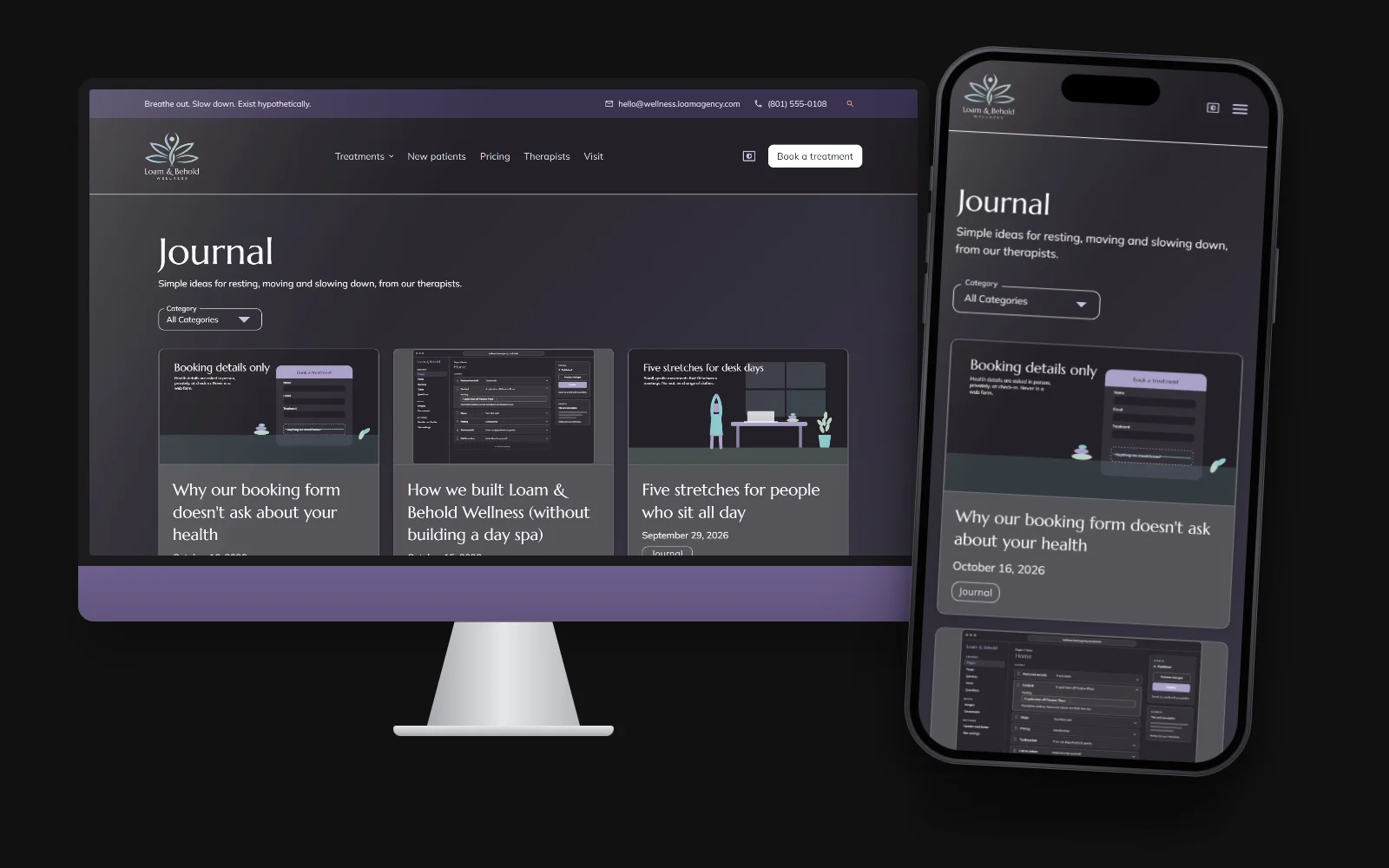
Quick answer: visit Loam & Behold Wellness, a fictional day spa Loam built to show what a spa's website can do, treatment guides and articles included.
The spa, its therapists, its treatments and its reviews are invented. The website is real: the editor, the blog and the forms all work, built to the same standards as the sites we make for real businesses. Read one of its guides as if you were a nervous first-timer, and ask whether your own guests have something like it.
We explain why each of ten very different businesses benefits from writing in our article on why every business needs a blog, and you can see all ten fictional businesses in our custom website examples. If you run a spa or wellness studio and want first-time guests to arrive already at ease, tell us about your studio.
Post Details
September 1, 2026