
Why does a martial arts school need a content strategy?
Parents and new students ask the same questions before every trial class. A school that answers them online fills its classes with people ready to start.
A martial arts school needs a content strategy because nobody signs up on impulse. A parent weighing karate against swimming for an anxious eight-year-old, or a forty-five-year-old who has wanted to train for twenty years and is afraid of looking foolish, will read for a week or two before booking a trial. If your website answers their real worries in plain language (what age, what happens in the first class, whether anyone gets hurt, what it costs), the people who walk onto your mat already want to be there.
A content strategy is the decision about which of those worries to answer, in what order, and when in the year. It is also a plan for keeping the school's honesty visible: what contact students actually make, how you look after children, what a black belt really takes. Done well, it fills trial classes in January and September and keeps families enrolled long after the first stripe.
Who are you really writing for?
Quick answer: Two people who rarely say what they are afraid of: the parent deciding for a child, and the adult beginner deciding for themselves. Write for both, separately.
The parent
Parents are buying more than kicks. They want confidence, focus and a safe place for their child to spend two evenings a week. Their questions are practical (age groups, class times, cost, what to wear) and protective (who teaches, how contact is supervised, whether instructors working with children have been background checked, what happens if their child cries in the first class).
The adult beginner
Adults worry about fitness, age, injury and embarrassment: whether everyone else will be twenty and flexible, and whether a bad knee rules them out. One discouraging page is enough to put it off another year.
The path from reading to joining
Both readers follow a similar path: a search, a few articles, a trial class, a first month, then a membership that may last years. A school wins a family over the first few belt tests, not at the trial, so your articles should serve every step.
What should a martial arts school write about first?
Quick answer: The six questions every trial student brings: age groups, the first class, safety, belts, cost and whether adults are welcome. Answer each in its own article before writing anything else.
- Classes by age, and what each one teaches. Your youngest group and why it starts there, how the children's classes differ from the teens', and what each age is working on.
- A walk-through for nervous beginners. Minute by minute: where to park, where to change, whether to bow, what to wear if they have no uniform, what the warm-up involves, and what the instructor will ask of them. This is often the most read page a school has.
- How we teach contact and keep it controlled. Covered in detail below, because it decides more enrollments than any other article.
- Every rank and roughly how long it takes. The belt order, what each test involves, the usual range of time between ranks, and why it varies. Be honest that a black belt takes years of steady training.
- Tuition, uniforms and testing, all listed. Every cost a family will meet in the first year: monthly fees, the uniform, sparring gear, testing fees, tournament entries, and whether there is a contract. Hidden costs are the fastest way to lose a parent's trust.
- Adult classes for every fitness level. Who trains in the adult class, how you adapt for injuries and age, and what the first month feels like for someone who has not exercised in years.
After those six come instructor introductions, a short history of your style and event recaps. They build community, but only once someone is through the door.
How do you write honestly about safety?
Quick answer: Describe exactly what contact happens at each level, how it is supervised and what protective gear is used, admit that minor knocks happen, and never call training "completely safe".
Parents can tell when they are being reassured instead of informed. Trust them with real detail:
- What contact looks like at each stage. Beginners might train techniques in the air and on pads for months before any partner work. Say when light sparring starts, what "light" means in your school, and who decides a student is ready.
- Supervision. How many instructors teach a children's class, who pairs students up, and how you match partners by size and experience.
- Protective gear. What is required for sparring (gloves, mouthguards, shin guards, headgear if you use it) and who provides it.
- What happens when someone gets hurt. Whether instructors hold current first aid training, where the first aid kit lives, how parents are told, and when a student sits out.
- Who teaches children. Whether instructors and assistants who work with children are background checked, and whether a parent can watch classes.
- The honest part. Martial arts is physical. Bruises, a bumped nose or a sore wrist happen in any contact sport. Saying so plainly is more reassuring than pretending otherwise.
This is general guidance, not legal advice. Your insurer, your style's governing body and local rules may set their own requirements for supervision, waivers and checks. Ask them before you publish, and make sure the article matches what you actually do on a busy Tuesday night, not just what the policy says.
How should you handle children's photos and names?
Quick answer: Show a child on your website only with a parent's written permission for that use, keep names off unless the parent agrees, and take any photo down promptly when asked.
Photos of children need the most care of anything on a dojo's website. This is general guidance rather than legal advice; privacy and consent rules differ by place, so check with your own advisor or governing body. Habits that serve most schools well:
- Ask in writing, for the specific use. A permission form that names the website and social media separately lets a parent say yes to one and no to the other. Keep the signed forms somewhere you can find them.
- Make it easy to say no, and easy to change their mind. A parent who withdraws permission should see the photo gone within days, not months.
- Leave names off by default. A first name next to a photo, the school's location and a class time together tell a stranger too much. If a family is happy to see their child's name on a tournament result, ask them first.
- Check the background. A school logo on a sweatshirt, a car number plate, or a younger sibling in the corner can all be identifying.
- Use safe defaults when permission is missing. Shots from behind, hands tying a belt, a row of shoes at the mat's edge, or adult classes only.
- Ask adults too. An adult beginner may not want colleagues finding a photo of them mid-roll.
A school that is visibly careful here earns trust from the parents who notice, and they are exactly the parents you want.
When should a martial arts school publish?
Quick answer: Have your beginner guides fresh before the two enrollment waves, the new year and back-to-school, and publish one short piece each month between them to keep the school visibly active.
- New year. Adults make resolutions and parents look for winter activities. Publish a beginners' guide, an adult classes article and the next belt testing dates in December, so they are found in the first week of January.
- Spring. A tournament recap (with the consent habits above), summer camp details while parents are still planning, and a fresh look at safety in sparring as students move up.
- Late summer. Back-to-school classes, a refreshed first-class walk-through, and a parent FAQ built from every question asked at last year's trials. Publish in August, before the school timetable is settled and families commit their evenings.
- Winter holidays. The holiday schedule, a year in review, and a gift trial class, which suits grandparents looking for a present that is not another toy.
A realistic pace is one substantial article a month plus a short recap. An owner who teaches every evening can manage that by writing in the quiet weeks of early summer and early December.
What does a martial arts school's first 90 days look like?
Quick answer: Month one builds the path from search to trial class, month two builds trust, and month three prepares for the next enrollment wave and sets up the habits that make the rest easier.
Month one: the trial-class path
Write the first-class walk-through, the classes-by-age article and the full cost article. Link each one to your trial booking form. Ask whoever runs the front desk which questions new families ask on the phone, and make sure all three articles answer them.
Month two: the trust pieces
Write the safety article and the belt guide. Have one or two parents who joined recently read both and mark anything confusing. Then write short introductions for each instructor, with their consent and approval of the final words.
Month three: the next wave and the paperwork
Look at the calendar above and write the guide for whichever enrollment season comes next. At the same time, put a photo permission form into your enrollment paperwork if it is not already there, so you have consent on file before you need a photo. End the month by asking every new student how they found you and what they read.
How do you write one article that a nervous beginner will trust?
Quick answer: Start with the answer, describe things as a first-timer would experience them, explain every term of your style the first time it appears, and have someone outside the school read it before it goes live.
The head instructor usually knows the answers best, but years on the mat make it hard to remember what a beginner does not know. Words like gi, kata, kumite, sensei, dojo kun or rei are second nature to you and foreign to a parent. Use them if they matter to your school, and explain each one in plain words the first time.
A shape that works for most articles:
- Answer the question at the top. "Children can join our youngest class from age five." Then the reasons.
- Describe it from the student's side. What they will see, hear and be asked to do, in the order it happens.
- Name the worry and meet it. "If your child is shy, they can watch the first ten minutes from the side." Specific beats soothing.
- Show it, carefully. Photos of the space, the mats, the changing area, and students whose families have agreed.
- Tell them what to do next. Book a trial, what to bring, where to park.
Most of these articles land comfortably between seven hundred and twelve hundred words. Write in your own voice: families are choosing a teacher.
Before publishing, give the draft to a parent who joined in the last year and to an adult who has never trained. Ask each to circle anything they did not understand or that worried them. Fix those first.
How do you know your articles are working?
Quick answer: Count trial classes booked from article pages, listen for articles mentioned at the first class, and watch whether students stay past their first belt; ignore traffic from relatives sharing a tournament post.
What to watch:
- Trial bookings that came from an article. Ask your web team whether the booking form can show which page a family was on when they booked.
- Searches that bring people in. Google Search Console, which is free, shows the searches behind your visits. Phrases that pair a class type with your town, or questions like "what age can kids start karate", show your guides are being found.
- What new students say on the mat. If a parent arrives saying "I read that my daughter can watch first", the walk-through did its job. Ask at every trial.
- Retention past the first belt. Families who understood the belt system and the costs from the start tend to have fewer surprises later. Keep an eye on how many first-month students reach their first test.
What not to chase: a spike when a tournament recap goes round a family group chat, likes on a sparring clip, or total page views. A handful of local families booking trials is the result that matters.
What mistakes do martial arts schools make online?
Quick answer: Hiding prices, leading with fight footage that frightens parents, filling pages with jargon, posting children without consent, and promising outcomes no school can guarantee.
- No prices anywhere. Families assume the worst, or assume a hard sell is waiting at the desk. List every cost.
- A homepage full of full-contact sparring and trophies. It thrills current students and scares the parent of a timid six-year-old. Lead with beginners and the first class.
- Jargon without explanation. A timetable that lists only Japanese or Korean class names leaves a newcomer guessing which class to book.
- Children's photos without written permission. Covered above, and the one mistake on this list that can damage families' trust in a single afternoon.
- Promises nobody can keep. "Bully-proof your child" or "guaranteed black belt in three years" sets up disappointment and sounds like a sales pitch. Describe what you teach and how.
- Running down other styles or schools. It reads as insecurity.
- A timetable that is a year out of date. A family that turns up to a class that no longer runs does not come back.
What should a martial arts school ask a web team before hiring one?
Quick answer: Ask whether you can update the timetable and prices yourself, how trial bookings reach you, how quickly a photo can be taken down, and how parents' details submitted through forms are protected.
- Can I change the class timetable, prices and testing dates myself, and how long does it take? Ask them to show you, live.
- How does a trial booking reach us, and how is spam kept out? A booking lost in a junk folder is a family lost.
- If a parent asks us to remove a photo tonight, can I do it myself in a few minutes? The right answer is yes, without a support ticket.
- How are the details families send through our forms kept secure, and who reviews the site's security after launch? Parents share names, ages and phone numbers with you. Ask what a monthly maintenance report covers.
- Will our questions and answers be marked up so search engines and AI assistants can read them? Your parent FAQ is exactly the kind of page that benefits.
- Can I write the back-to-school guide in June and preview it before it goes live?
- If we move on one day, do our articles and photos come with us?
A good team asks about your enrollment seasons and your students before it talks about colors. A poor one promises rankings or wants to start with a logo.
Where can you see a martial arts school website like this working?
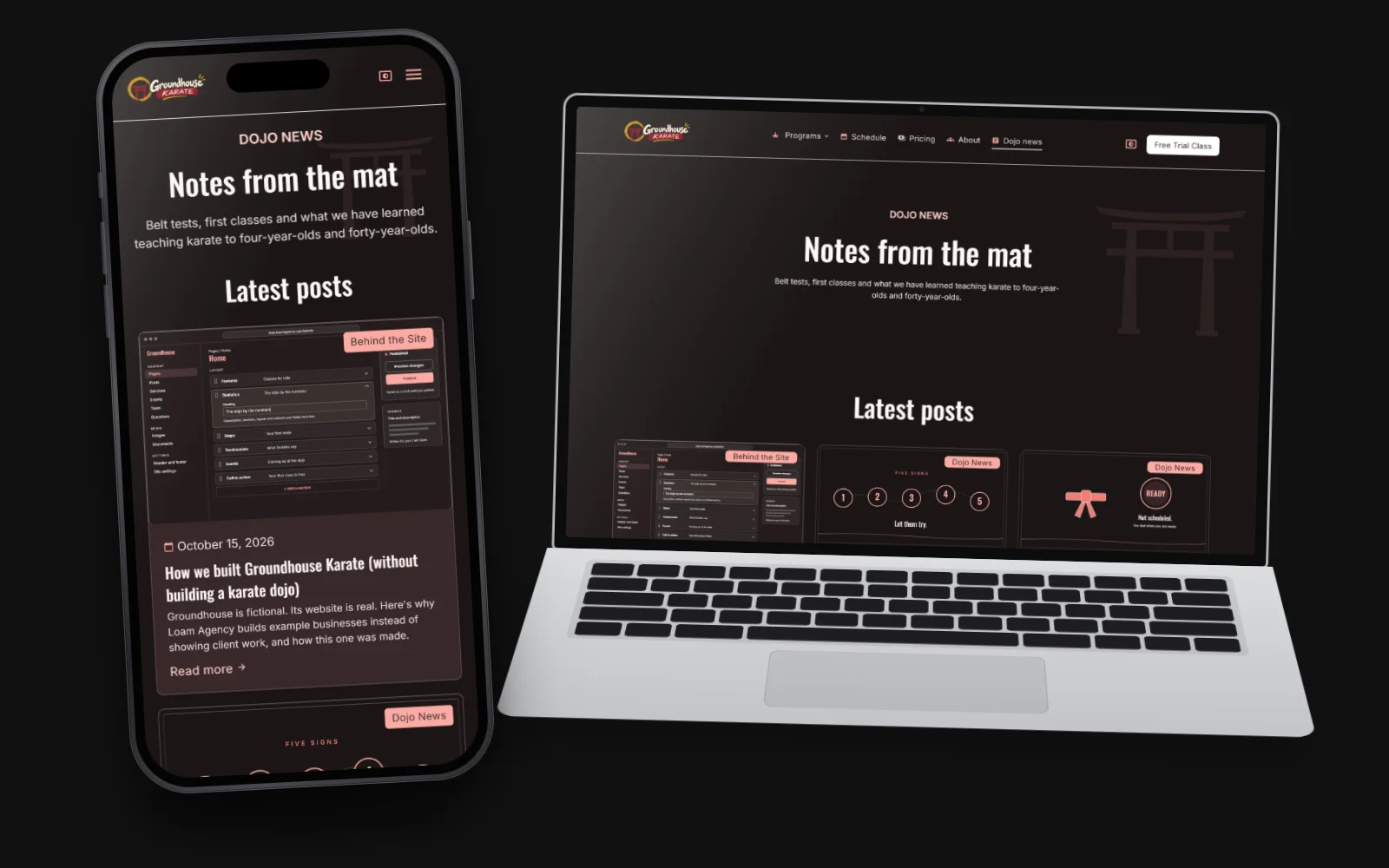
Quick answer: Groundhouse Karate is a fictional karate dojo Loam built to show what a martial arts school's website can do, beginner guides and articles included.
Its instructors, students, prices and reviews are invented. The website itself is real, with a working editor, forms and blog, so you can see how a first-class guide and a belt page fit together. For the case for publishing across several kinds of business, the dojo section of our article on why every business needs a blog puts it in a few paragraphs. The rest of the fictional businesses are in our custom website examples.
When you want to talk about your own school, its students and the families you hope to reach, get in touch with Loam. A real person will read what you send.
Post Details
August 20, 2026