
Why does a logistics company need a content strategy?
Shippers choose a carrier before they ever call one. Plain articles on routes, packing, tracking and delays put your company on the short list.
Because every carrier and forwarder promises on-time delivery, and a shipper who has been burned stops believing the promise. What they look for instead is proof that you understand the work: how to choose between a truck and a flight, what makes up a freight bill, what happens at a dock when the appointment is missed, who calls when a load is late. A content strategy is the plan for publishing those answers, in an order that matches how shippers actually choose, so your company is the one they learned from.
Most freight websites say the same few things about solutions, networks and commitment. Swap the logos and nobody would notice. The knowledge that sets a good operation apart sits with the dispatchers, the dock leads and the customs desk, and it usually gets shared one phone call at a time. Writing it down lets the next shipper hear it before they ask anyone for a rate.
Why do shippers read before they ask for a rate?
Quick answer: because the price of a bad shipment is rarely the freight bill, and the person who books it will be the one explaining a stopped line or an empty shelf.
Freight gets bought in two very different ways. One is urgent: something is stuck, short or broken, and a shipper needs an answer this afternoon. That person searches a question ("can a pallet get there tomorrow", "what does air freight need by when") and calls whoever answers it clearly. The other is slow: a company reviewing its carriers, opening a new region or moving its stock into an outside warehouse. Those buyers read for weeks, compare several providers, and pass links around a group that includes operations, purchasing, finance and sometimes the customer's own receiving team.
A good article serves both. The urgent reader gets the answer in the first few lines and a phone number. The careful reader gets the reasoning, the trade-offs and the questions to ask.
There are three more readers worth planning for:
- The person receiving the freight. They did not choose you, but a page about dock appointments and what to check before signing decides how they feel about you.
- Drivers and warehouse staff looking for work. They read about schedules, equipment and how people are treated, and they can tell when nobody in the building wrote it.
- Customers you already have. A clear explanation of a fee or a delay is the difference between an annoyed email and a shrug.
Which questions should a logistics company answer first?
Quick answer: the ones your coordinators answer every day, beginning with how to choose between ground, air and ocean and what goes into a price.
Sit beside the people who take the calls for a week and write down every question, in the words the caller used. Add the ones your billing desk gets. The same short list will keep coming back.
A starting list for a carrier, forwarder or warehouse:
- Which way should I ship this? A plain comparison of ground, air and ocean, built around the deadline, the weight and what a late day would cost the reader.
- What goes into a freight price? Distance, weight, dimensions, freight class, fuel and the extra charges people are surprised by, each explained once and clearly.
- How should I pack a pallet? Stacking, wrapping, labels and photographs, written by someone who unloads trucks.
- How will I know where it is? What your tracking shows, where each update comes from, how often it refreshes, and what happens when a signal goes quiet.
- What if it is late or damaged? Who calls whom, what to note on the delivery receipt, what to photograph, and how a claim moves.
- What papers does an export need? A checklist of the usual documents, who prepares each one, and how early each has to be ready.
After those six, write the answers only you can give: a guide to each lane you run often, the quirks of the port or border crossing you use most, how receiving works at your warehouse, and how a new customer's first month goes.
Why lanes deserve their own pages
People search for freight by place. "Shipping from here to there" is a real question with a real answer: how often you leave, how long it usually takes, what slows it down, and what you would do if it had to be there sooner. A page for each lane you know well gives search engines and AI assistants something specific to find, and it gives your sales team a link to send instead of a paragraph to retype.
How often should a logistics company publish, and when?
Quick answer: two useful articles a month, published ahead of the season they are about, with the lane pages and fee guide checked every quarter.
Freight runs on a calendar, and readers start worrying before the season starts. Winter weather guidance belongs in late autumn. Produce season squeezes trucks in spring. Companies that import for the holidays book space in summer. Cutoff dates need to be up well before the first customer asks, and many shippers put their freight out to bid around the turn of the year.
A year might run like this:
- Winter: weather plans and what a closed road means for a delivery date, a refresh of the rate and fee guide, and the pallet packing guide.
- Spring: produce season and truck capacity, moving freight that heat can spoil, and the customs checklist.
- Summer: when to book space for peak season, how storms change routes, and how overflow warehouse space works.
- Autumn: holiday cutoff dates, a checklist for a freight bid, and planning next year's lanes.
Some writing is urgent and cannot be scheduled: a port delay, a closed pass, a change in a carrier's rules. Keep a short format ready for it, with what happened, who is affected, what you are doing, and when you will update the page. Write that note once, date it, and send every customer the same link. Then take it down or mark it closed when it ends, because an old alert is worse than none.
What should the first 90 days look like?
Quick answer: fix the quote path and publish the two articles callers need most, then write your best lane, then hand the habit to the people who answer the phones.
Weeks one to four: the pages that save phone calls
- Collect the questions from a week of calls, emails and billing disputes.
- Publish the guide to choosing between ground, air and ocean.
- Publish the explanation of a freight price, with each extra charge in plain words.
- Put a list of what you need for a quote beside the quote form: origin, destination, dimensions, weight, freight class if known, ready time, and anything unusual about the dock.
Weeks five to eight: one lane and one dock
- Pick the lane you run best and write its page with the coordinator who runs it.
- Write the pallet guide with your dock lead, and take photographs of pallets your own team built for the purpose.
- Add a page for receivers: how appointments work, what to check, and how to reach a person.
Weeks nine to thirteen: make it a habit
- Write the delay and damage article, and have whoever handles claims check every line.
- Give one coordinator ten minutes a week to add new questions to a shared list.
- Draft the next seasonal article before this season ends.
By the end of the quarter a stranger can work out how to ship with you, what it depends on, and what happens on a bad day. That last part is the one most easily left out.
How do you write one freight article well?
Quick answer: answer in the opening lines, show one worked example with made-up figures, and have the person who does the job read it before it goes up.
- Take one question, in the caller's words. "Why was my freight bill higher than the quote" will be found. "Understanding accessorial charges" will not.
- Answer first. A warehouse manager reading on a phone between trucks should have the gist before the first scroll.
- Explain the term when you use it. Detention, demurrage, reweigh and liftgate are everyday words inside your building and nowhere else.
- Work an example. One pallet, one lane, one deadline, with illustrative figures labeled as illustrative. Comparing two choices for the same pallet teaches more than a page of definitions.
- Say when not to use you. If a load is better by rail, or too small for what you do, say so. Readers remember the company that talked them out of the wrong service.
- End with the next step. The exact details to send, and the name or desk that will reply.
Who writes it
The coordinator, dock lead or customs specialist supplies the substance. A short recorded conversation is enough: ask them to explain the answer the way they would to a new customer, then have someone shape it into an article and send it back for correction. Put their name on it. In a business where shippers complain that nobody owns the problem, a named person is an argument in itself.
How long it should be
A comparison guide or a lane page can run past a thousand words, since readers treat it as reference. A seasonal notice might be a few paragraphs. Use a table where readers are comparing things, and a numbered list where they are doing things in order.
What does a logistics company need to be careful about?
Quick answer: promises about time, wording about cargo cover, anything that reveals a customer's freight, and an exact statement of what your company is licensed to do.
This section is general guidance and does not replace advice from your own counsel, insurer or compliance lead. The rules vary by country and by kind of freight.
- Transit times are estimates unless you guarantee them. Say "usually" when you mean usually, and explain what changes the answer. If you do offer a guaranteed service, link to its terms.
- Cargo cover has limits. A carrier's liability and an insurance policy are different things, and both depend on contracts and law. Explain the difference in general terms, tell readers to ask for the limits in writing, and let your insurer or counsel check the page.
- Say what you are. A carrier, a broker, a forwarder and a warehouse each have different responsibilities. State which of these your company is, and which licenses or authorities it holds today, in the words the authority uses.
- Keep customers' freight private. Do not name a customer, show a label, or describe a route, value or schedule that would help a thief. Get written permission before a customer's name, goods or building appears anywhere.
- Watch the background of every photograph. Screens, seals, plates, keypads and whiteboards show up more often than people expect.
- Customs and dangerous goods articles stay general. Explain the steps and who is responsible, then send the reader to the official source and to your specialist. Classification and declaration are decisions about one shipment, made by qualified people.
- Safety claims need support. If you describe your safety practices, describe what you do. Leave scores and comparisons off the page unless you can source them and keep them current.
- Date fuel and fee pages. A surcharge table with no date starts arguments with billing.
How will you know the articles are working?
Quick answer: look for quote requests that start on an article and arrive complete, and for fewer calls asking the questions you have answered.
Freight volumes swing with the season and the economy, so a traffic chart on its own says very little. These say more:
- Quote requests from article and lane pages. Note the page each one began on, and whether it turned into a shipment.
- Completeness. When the checklist is doing its job, fewer requests come back for dimensions, dock hours or a ready time.
- Repeat calls. Ask coordinators whether they are explaining the same fee less often, or sending a link instead.
- Searches by lane and service. Search Console shows whether your lane pages appear for the places they name.
- Claims and paperwork. Better packing photographs and better notes on delivery receipts are a sign that people read the damage article.
- Applications. Ask every driver and warehouse applicant what they read before applying.
Give a lane page a season before you judge it. A shipper may read it long before they have a load to move.
What mistakes do logistics companies make with content?
Quick answer: writing about themselves in the abstract, hiding the price logic, going silent during disruption, and leaving a year-old notice on the home page.
- "End-to-end solutions." It describes every provider and helps no one. Name the thing you move, where, and how.
- Industry news with no consequence. A report about global rates is not useful until you say what it means for a reader with ten pallets and a date.
- Fees explained only on the invoice. People accept a charge they understood beforehand and fight one they did not.
- Tracking as the whole story. A map answers where. It does not answer what happens next, or who is handling it.
- Only good days. A company that never mentions delay sounds as if it has not planned for one.
- Photographs of someone else's trucks. Use your own yard, your own docks and your own people, with their permission.
- No page for receivers. Half the people who deal with your company every day never bought anything from it.
What should a logistics company ask a web team before hiring one?
Quick answer: ask how your coordinators will publish an urgent notice themselves, how quotes reach the right desk, and how the site keeps working when a map or tracker does not.
- Can a coordinator post and close a service notice from a phone, with no developer involved? Weather does not wait for a support ticket.
- How will each lane and service page be found on its own? Expect an answer about headings, descriptions, structured data and internal links.
- Where do quote requests go, and what happens after hours? Routing by service or region matters, and so does keeping spam out of the desk's inbox.
- What does a visitor see if the tracking feed is down? The site should say so plainly and give a phone number.
- Can the maps and charts be read without a mouse, and by a screen reader? Receivers and drivers use all kinds of devices in all kinds of light.
- How quickly does it load on a weak signal? Many of your readers are in a yard.
- Who looks after security, and how often will a person check it? A site that touches shipment details deserves a regular review and a written report.
Where can you see a logistics company's articles working?
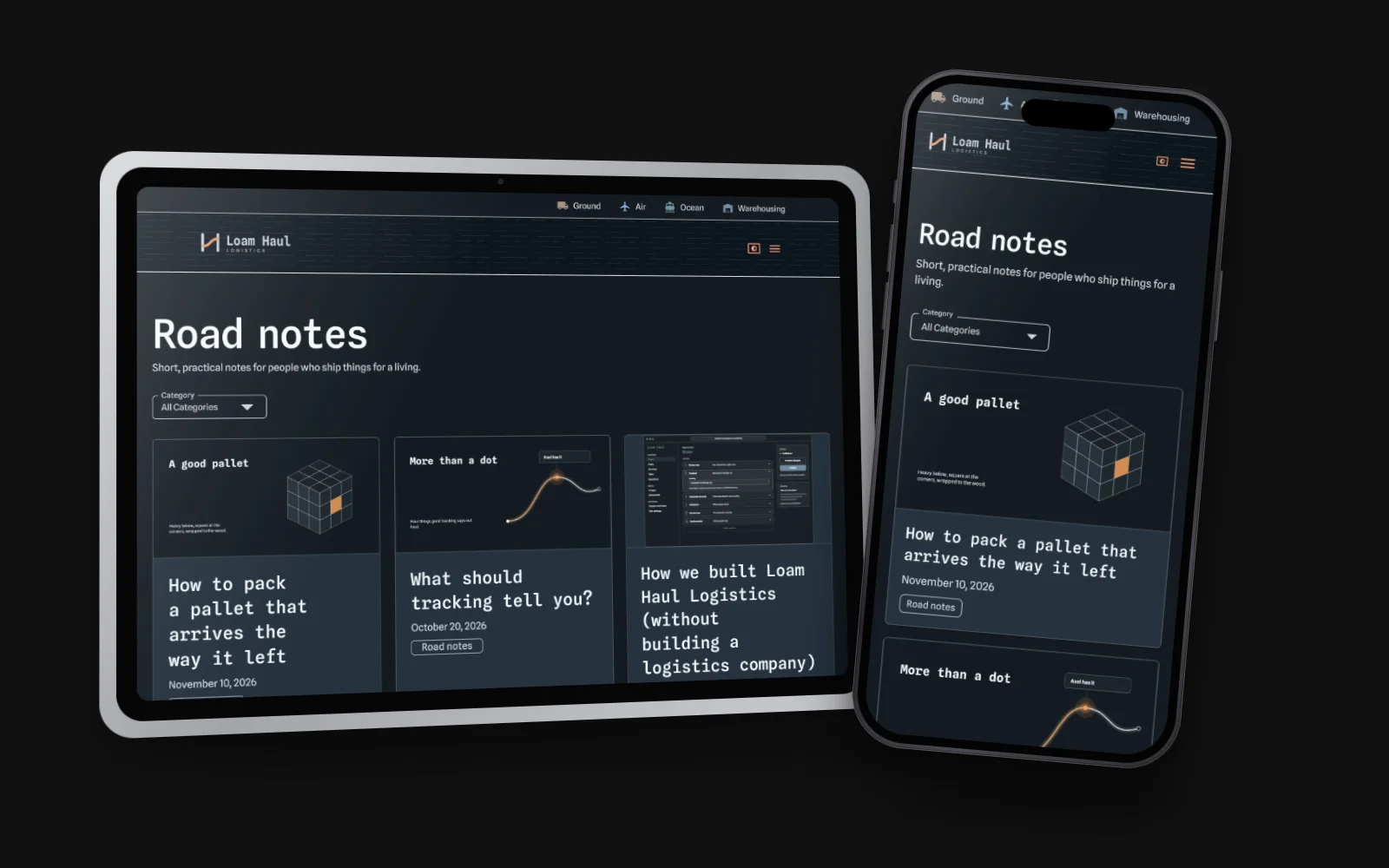
Quick answer: on Loam Haul Logistics, a fictional freight company Loam built so you can walk through a whole logistics site, notes for shippers included.
The company, its coordinators, its loads and its figures are invented, and nothing on it is moving. The site itself is real: a network map, a page for tracking a shipment, a theme for each way to ship, and longer notes on choosing a service, reading a tracker and building a pallet. For the short version of this argument, read why logistics is one of the industries that needs a blog, or look through the rest of our custom website examples.
If your coordinators already have the answers and your website does not, tell us about your operation.
Post Details
November 17, 2026