
Why does a landscaping company need a content strategy?
A landscape project is decided over months. The company that taught a homeowner what to ask is the one that gets the call.
Because a new patio, garden or retaining wall is one of the largest things a household buys for its home, and people take their time over it. A homeowner might browse for a whole winter before asking anyone to come out and look at the yard. A property manager weighs a grounds contract against a budget and a board. By the time either one calls, they have usually decided whose advice they trust, and it is the company whose articles answered their questions while they were still dreaming.
A content strategy for a landscaping company is a plan for being that company: writing down what you explain at every site visit, publishing it a season before people need it, and showing your finished work with the story of how it was done.
Why do homeowners research a landscape project for so long?
Quick answer: because it costs real money, it changes how a family lives at home, and most people have never bought one before.
Think about what a homeowner does not know when they first imagine a patio. They do not know whether pavers or natural stone suits their budget, how much digging happens before anything is laid, whether the slope by the back door is a problem, or how long the yard will be torn up. They are nervous about choosing the wrong company, and they are a little embarrassed to ask basic questions.
So they read. They look at photos, compare materials, and try to work out what a fair quote looks like. The landscaping company that answers those questions plainly becomes the expert in their mind before any visit happens.
Property managers research differently
A property manager running an apartment complex, an office park or a homeowners association reads with different questions. They want to know whether you show up on schedule, how you communicate, what a maintenance contract covers, how you handle snow or storm cleanup, and whether your crews are insured. They often plan grounds budgets months ahead, so articles about planning next year's work reach them at the right moment. Our short piece on why every business needs a blog explains the landscaping case among nine other industries; this is the full version.
What should a landscaping company write about?
Quick answer: the questions you answer at every site visit, the seasonal care your clients forget, and project stories that show the work from first sketch to finished yard.
Every estimate visit is a list of article topics. Write down what people ask you this month and you will have more ideas than you can use. A good first six:
- What does a new patio cost? A guide to patio costs by size and material. Explain what drives the price: excavation, base preparation, drainage, access for equipment, the material itself, and edging. If you are comfortable giving honest ranges on your own site, do it; homeowners value a company that does not make them guess.
- When should I plant? A planting calendar for your region, not a national one. Your local frost dates, soils and rainfall are exactly the knowledge a big website cannot offer.
- How long does a project take? From design to finished garden: consultation, design, permits where needed, scheduling, installation, and the cleanup and walkthrough at the end.
- What should a contract cover? A checklist before signing: scope, materials, drawings, payment schedule, warranty on plants and hardscape, who handles permits, and what happens if the weather delays work.
- How do I keep the lawn healthy? A season-by-season lawn plan for your climate, covering mowing height, feeding, aeration, overseeding and watering.
- Can you show past work? Project stories with before-and-after photos and an honest account of what the job involved.
Beyond those, keep a list of smaller topics: which plants suit shade under mature trees, how to tell whether a retaining wall needs an engineer, what to do with a yard that floods after storms, or how to prepare beds for winter.
Project stories, not just galleries
A gallery of pretty photos shows that you can make a yard look good. A project story shows how you think. Explain what the client wanted, what the site was like, the problems you found (a buried drain line, clay soil, a slope that sent water toward the house), how you solved them, and how the space is used now. That is the story a homeowner remembers when they meet you.
What should you watch out for when you show clients' homes?
Quick answer: get the homeowner's permission before you publish photos of their property, and keep house numbers, street signs and faces out of the frame.
A finished yard is part of someone's home. Ask permission before you photograph it for your website, and tell the owners how it will be used. Many clients are proud to be featured; a few would rather not be, and their wishes come first.
Keep identifying details out of photos. Avoid house numbers, street signs, license plates, and children in the background. Describe the neighborhood in general terms, not the street. For property-management work, check with the manager or the board before showing a property, since residents may have concerns of their own.
How often should a landscaping company publish?
Quick answer: one project story and one care guide a month is plenty, written a season ahead so each piece is ready before people start planning.
Landscaping lives by the calendar, and the most common timing mistake is publishing a guide in the season it describes. By the time someone searches "when to plant" in spring, they are already planning; an article written in late winter will have been found by then. Write planting guides in late winter, fall cleanup guides in late summer, and winter protection guides in early fall.
Use your slow months. Winter is when crews have less field work and the office has time to write up last year's projects.
A year might look like this:
- Spring: the spring planting guide, an announcement that design season has started, and the patio cost guide for people planning summer projects.
- Summer: the lawn care plan, a guide to watering and irrigation for dry spells, and a project story from the spring installs.
- Fall: fall planting (often the better season for trees and shrubs in many climates), a cleanup checklist, and a piece on planning next year's project now.
- Winter: protecting plants and hardscape from frost, holiday lighting, and a look back at a year of projects.
Publish each one a few weeks before its season opens, so it is waiting when readers start looking.
What does the first 90 days look like?
Quick answer: start with the cost and project-timeline articles that every quote needs, then add one project story and one seasonal guide timed for the season ahead.
The order matters less than starting with the questions closest to a quote request.
Month one: answer the money question
- Write down every question asked on your last ten estimate visits.
- Write the patio cost guide, explaining what drives the price on the jobs you actually do.
- Write the project-timeline article, from first visit to finished yard.
- Link both from your quote request page.
Month two: show the work
- Pick a recent project you are proud of, ask the owner's permission, and gather before, during and after photos.
- Write the project story: what they wanted, what you found, how you solved it.
- Write the contract checklist. Homeowners appreciate a company that hands them the questions to ask.
Month three: get ahead of the season
- Look at the calendar and write the next season's guide now: a planting guide if spring is coming, a cleanup checklist if fall is.
- If you serve property managers, write one article for them about planning next year's grounds work.
- Ask your office to note when a new client mentions reading something on your site.
After three months you have the answers that come up at every estimate, one story that shows your craft, and a guide that will be waiting when the season turns.
How do you write one article well?
Quick answer: explain it the way you would standing in the client's yard, add your own photos, and have the person who did the work check the details.
- Start with one question a client asked. "Do I need drainage behind a retaining wall" is a better article than "Retaining walls."
- Answer it first, in a sentence or two. Then explain why, the way you would on a site visit.
- Be specific to your region. Name the plants that do well locally, your typical soil, and your town's planting dates.
- Use your own photos. Stock images of perfect gardens do not convince anyone; your crew's real work does.
- Let the expert talk. If your crew lead knows more about pavers than you, interview them and write it up.
- Keep it readable. A care guide might be short and practical; a cost guide or a project story can run longer, because readers want the detail.
- Have the right person check it. The person who did the project confirms the details; you confirm nothing promises more than you deliver.
- End with an easy next step. Invite the reader to request a site visit or ask a question.
How will you know it is working?
Quick answer: count the quote requests that begin on an article, and listen for clients who arrive already knowing what they want.
- Quote requests from cost and project articles. Note where each request came from and ask new clients how they found you.
- Searches for your services in your towns. Search Console shows which services and place names bring people to your site.
- Readers who come back each season. A homeowner who reads your spring guide and returns for the fall cleanup checklist is warming up to you.
- Better first conversations. When clients arrive having read your cost guide, estimates go faster and expectations are realistic. Your estimators will notice before any report does.
- Property-management inquiries, if you wrote for that audience.
Ignore month-to-month comparisons across seasons. Visits in February and visits in May are not the same thing. Compare each season with the same season last year.
What mistakes do landscaping companies make with their content?
Quick answer: galleries with no story, guides published too late, generic national advice, and cost articles that never get to the point.
- Photos with no context. A beautiful patio photo with no explanation leaves homeowners guessing what it involved.
- Publishing in season. A spring planting guide posted in May arrives after most planning is done.
- National advice. Planting dates copied from a general gardening site may be wrong for your climate, and readers in your area will notice.
- Dodging the cost question. An article titled "patio costs" that ends with "every project is different, call us" frustrates readers. Explain what drives the price, honestly.
- Forgetting property managers. If you want commercial maintenance work, write something for the people who sign those contracts.
- Letting the site go quiet. If your latest post is two summers old, homeowners wonder whether you are still in business.
- Showing a client's home without asking. It costs goodwill you will need for referrals.
What should you ask a web team before you hire one?
Quick answer: ask how easily you can post a project story with your own photos, whether pages will load fast on a phone, and who owns the site.
- Can I add a project story with photos myself, without calling you? You should be able to, and to preview it before it goes live.
- Will large project photos load quickly on a phone? Homeowners often browse from the couch or the yard itself.
- How will the site show up for searches in the towns we serve? A good team asks you which towns and services matter.
- Can we keep seasonal guides up to date year after year? Your planting calendar should be easy to revise each season.
- Who owns the website, the domain and the content? You should.
- How is the site kept secure, and how will we know? Ask what they check and whether you receive a report.
- Will you understand our seasons? A team that suggests publishing your spring guide in spring has not thought about your business.
Where can you see this working?
Quick answer: on Loam Improvement Landscaping, a fictional landscaping company Loam built to show what a landscaping website and its articles can do.
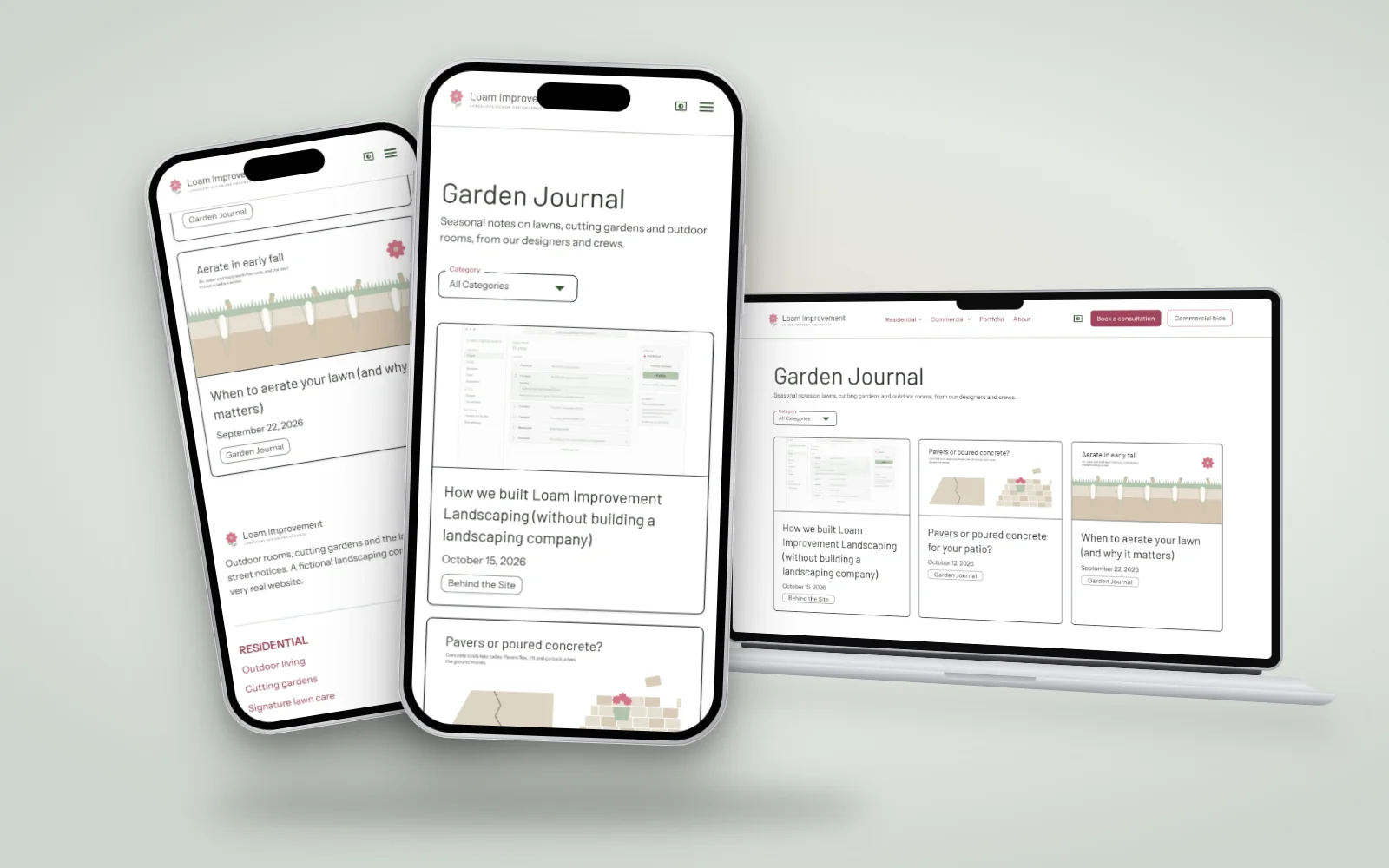
Take a look at Loam Improvement Landscaping to see project stories, cost guides and seasonal articles on a real working website. The company, its crews, its clients and its prices are invented; the site, its editor and its blog are genuine. You can browse the rest of the industries in our custom website examples.
If you want homeowners and property managers to arrive already trusting your advice, let's talk about your website.
Post Details
September 28, 2026