
Why does a manufacturer need a content strategy?
Engineers shortlist suppliers from what they can read. Clear capability and process articles get a shop on the list before the first call.
Because engineers and buyers decide who gets a drawing long before they pick up the phone. They search for a process, a material, a tolerance or a finish, read what a handful of shops say about it, and send a request for quote to the two or three that sounded like they knew the work. A job shop that explains its capabilities in those terms ends up on the shortlist. A shop with an equipment list, a stock photo of a lathe and a phone number waits for referrals.
A content strategy for a manufacturer is a plan for publishing the technical answers your engineers and estimators already give on the phone, so that the next buyer finds them first. It is not marketing in the glossy sense. It reads more like a good application note.
How do engineers and buyers choose a supplier?
Quick answer: in stages, from search to quote to first article to production, and at each stage they look for evidence that you understand their part.
The buying cycle for machined and fabricated parts is long and cautious, because a bad supplier costs an engineer a schedule and sometimes a product launch. It tends to run like this:
- Search. A design engineer or buyer has a part that needs a shop: a tight-tolerance aluminum housing, a run of stainless brackets, a powder-coated enclosure. They search for the process and material, often with a location.
- Shortlist. They read capability pages and technical articles to rule shops in or out. Can this shop hold the tolerance on that feature? Does it have the finish in house or send it out? Will it take a prototype quantity?
- Request for quote. They send drawings and a model to a few shops. The shops whose quotes come back fast, complete and with sensible questions move forward.
- Qualification. For anything beyond a one-off, quality gets involved: inspection reports, certifications, how nonconformances are handled.
- First article and production. The shop proves it can make the part, then makes it again, the same way, for years.
Articles do most of their work in the first two stages and some of it in the fourth. They do not replace a good estimator. They make sure the estimator gets the drawing. Our overview of why every business needs a blog has a short section on manufacturing; this article is the long version for a shop owner deciding what to write.
What should a manufacturer publish?
Quick answer: the technical answers that let an engineer rule you in: capabilities by process and material, inspection, lead times, what to send for a quote and how to design a cheaper part.
The best source of topics is your quoting inbox. Every question an engineer asks before or after a quote is an article. These six cover what most buyers need:
- What tolerances can you hold? A capability guide by process and material: what you hold routinely, what you can hold with extra setup or inspection, and which features make it harder.
- How fast can you turn parts? Lead times from prototype to production, and what makes them longer: material availability, outside finishing, inspection requirements, first-article approval.
- How do you inspect parts? Your inspection steps, the equipment you use, and the reports a customer receives.
- What do you need for a quote? A request-for-quote checklist: drawing format, model file, quantities, material and finish callouts, critical dimensions, required certifications.
- How can I make this cheaper? Design tips that cut machining time: inside corner radii, standard hole sizes, avoiding deep narrow pockets, loosening tolerances where they do not matter.
- Which finish should I choose? Anodize, powder coat, plating and passivation compared for wear, corrosion and appearance, with notes on how each affects dimensions.
Then add the pieces that show depth over time: a spotlight on a material you machine often, what changes between a prototype run and a production run, a write-up of new equipment and what it lets you make, and case notes that describe a problem and its solution without naming the customer.
Why capability pages need context, not just numbers
"We hold tight tolerances" means nothing to an engineer. A tolerance is only meaningful with the feature, the material and the size attached. Say which tolerances you hold on which features, in which materials, at which part sizes, and when you would rather talk before quoting. That candor is exactly what makes an engineer trust the rest of the page.
What does a manufacturer need to be careful about?
Quick answer: customer confidentiality above all, and certification or export-control claims stated exactly as they stand today; check anything specific with your quality manager or counsel.
This is general guidance, not legal advice. Export rules and certification requirements are specific, and your own counsel or compliance lead is the right person to confirm what you may say.
Never show a customer's part without written permission
Drawings, models and parts belong to your customers. Many are covered by nondisclosure agreements, and even when they are not, an engineer who spots another company's part on your website will assume theirs could be next. Get written permission before showing any customer part, name or logo, and keep that permission on file.
The safer habit is to photograph your own test pieces and sample parts, made to show a process or a finish. Describe customer work in general terms: "a thin-walled aluminum housing for a medical device maker" rather than a name and a photo. Engineers read that restraint as proof you will protect their drawings too.
Certifications exactly as they stand
If you are registered to a quality standard, say which one, and keep the claim current when the certificate is renewed. If you follow a standard's practices but are not registered, say that, in those words. If you are working toward registration, say "working toward", not "certified". Never use a certification body's mark unless you hold the certificate it represents. A buyer's quality team will check, and a claim that does not hold up ends the relationship before it starts.
Export-control claims
If you are registered under an export-control regime or are able to handle controlled technical data, state only what is true and confirmed, and only what your compliance lead is comfortable publishing. Do not imply capabilities or registrations you do not hold, and do not describe controlled projects at all. When in doubt, leave it off the page and let the conversation happen privately.
How often should a manufacturer publish?
Quick answer: one solid technical article a month, and capability pages updated whenever equipment or processes change.
Depth beats frequency here. A thorough guide to a process you do well can keep bringing in quote requests for years, because the physics of machining aluminum does not change every season. One article a month is a pace a shop owner or quality manager can keep without it taking over the week.
The exception is capability information. When you add a five-axis machine, a coordinate measuring machine or an in-house finishing line, update the capability pages that week. Engineers notice stale equipment lists, and an out-of-date list sends away work you can now do.
Even industrial work has a calendar. Plan around it:
- Winter: update the capability guide for the new year, publish the request-for-quote checklist, and spotlight a material.
- Spring: design tips that save a revision, a finishing options guide, and equipment news.
- Summer: quality and inspection, the path from prototype to production, and case notes with no customer names.
- Fall: year-end capacity, lead-time planning for buyers placing next year's orders, and a year in review.
What does the first 90 days look like?
Quick answer: fix the capability page and quote path first, then publish one deep technical guide, then a design-for-cost article, with the quality manager checking every claim.
Weeks one to four: the pages engineers check first
- Gather the last few months of quote requests and the questions that came with them.
- Rewrite the capability page by process and material, with honest tolerance ranges and the features that make them harder.
- Publish the request-for-quote checklist and link it from your quote form.
- Have your quality manager review every number on both pages.
Weeks five to eight: one deep guide
- Pick the process you are proudest of, and write the definitive guide to it from your shop's point of view.
- Photograph your own test pieces, not customer parts.
- Add an inspection article describing your steps and the reports you provide.
Weeks nine to twelve: help the engineer save money
- Write design tips that cut machining time, drawn from real quotes where a small change made a big difference (without naming the customer).
- Start a list of next topics from the questions your estimators keep answering.
- Ask your estimators to note when a buyer mentions reading something on your site.
By the end of the quarter, an engineer who finds you can tell what you make, how well, how fast and how to send you work, which is more than many shops manage.
How do you write one technical article well?
Quick answer: let the person who does the work explain it, write it for an engineer who is short on time, and have quality sign off on every number before it goes up.
- Choose one engineering question. "How do you hold flatness on thin aluminum plate" is an article. "Our CNC capabilities" is a sales sheet.
- Interview your best machinist or programmer. They know which fixtures, tools and sequences make the difference. Write down how they explain it.
- Open with the answer. Engineers skim. Give them the conclusion first, then the reasoning.
- Use precise language. Name materials by grade and processes by their proper names. Explain an acronym once.
- Show, with permission. Use photos of your own test pieces, your inspection equipment and your floor.
- Keep it as long as the subject needs. A design-tips piece might run a few hundred words; a capability guide for a core process may run much longer. Cut anything that is not useful to an engineer.
- Review it. The quality manager checks every tolerance and claim. The owner checks that nothing confidential slipped in.
- End with the next step. Tell the reader exactly what to send for a quote.
How will you know it is working?
Quick answer: trace quote requests back to the articles that started them, and watch whether those requests arrive more complete.
Industrial work comes in slowly and in big pieces, so a monthly traffic chart is the wrong yardstick. Watch the things that come before a purchase order.
- Quote requests from article pages. Note which page a request came from, and ask new contacts how they found you.
- Better quote packages. After the checklist goes up, requests should arrive with the right files, quantities and callouts more often. Your estimators will notice.
- Searches for your processes and materials. Search Console shows which process and material terms bring engineers to your pages.
- Downloads of spec sheets, if you offer them.
- Engineers who mention an article on a call. This is the clearest sign of all. Ask your team to write it down when it happens.
Ignore social media likes, total visits from outside your service area, and short-term dips. One good customer found through an article may be worth years of production work.
What mistakes do manufacturers make with their content?
Quick answer: brochure language with no numbers, equipment lists with no meaning, customer parts shown without permission, and a quote process hidden behind a phone call.
- "Quality is our priority." Every shop says it. Describe your inspection steps instead.
- Equipment lists without context. A list of machine model names tells a buyer little. Say what the machines let you make: part sizes, materials, tolerances.
- Unqualified tolerance claims. A single tolerance figure with no feature or material attached reads as either naive or dishonest to an engineer.
- Customer parts in the gallery. Even a well-meaning photo can breach an agreement and cost you the account.
- Loose certification wording. "ISO compliant" when you are not registered invites exactly the scrutiny you want to avoid.
- No clear way to send a drawing. If the only route to a quote is a phone number, busy engineers move on to the next shop.
- Writing once and stopping. One article and a dated equipment page signal a shop that may not answer emails either.
What should you ask a web team before you hire one?
Quick answer: ask whether they understand confidentiality, how engineers will send you drawings, and how your quality manager will review and change pages without them.
- How will an engineer send us a drawing and a model, and where do those files end up? Listen for a clear, secure answer.
- Can our quality manager edit a capability page and preview it before it goes live? Technical claims need technical review.
- Will our pages show the right technical terms to search engines? A good team asks you what engineers search for rather than guessing.
- How do you handle photos of parts? A good team will ask whether you have permission before you think to mention it.
- Who owns the site and its content? You should, including the domain.
- How is the site kept secure, and how often is it reviewed? Your customers trust you with their drawings; your website should not be the weak point.
- Have you written for engineers before? Ask to see an example, and check whether it reads like a datasheet or a brochure.
Where can you see this working?
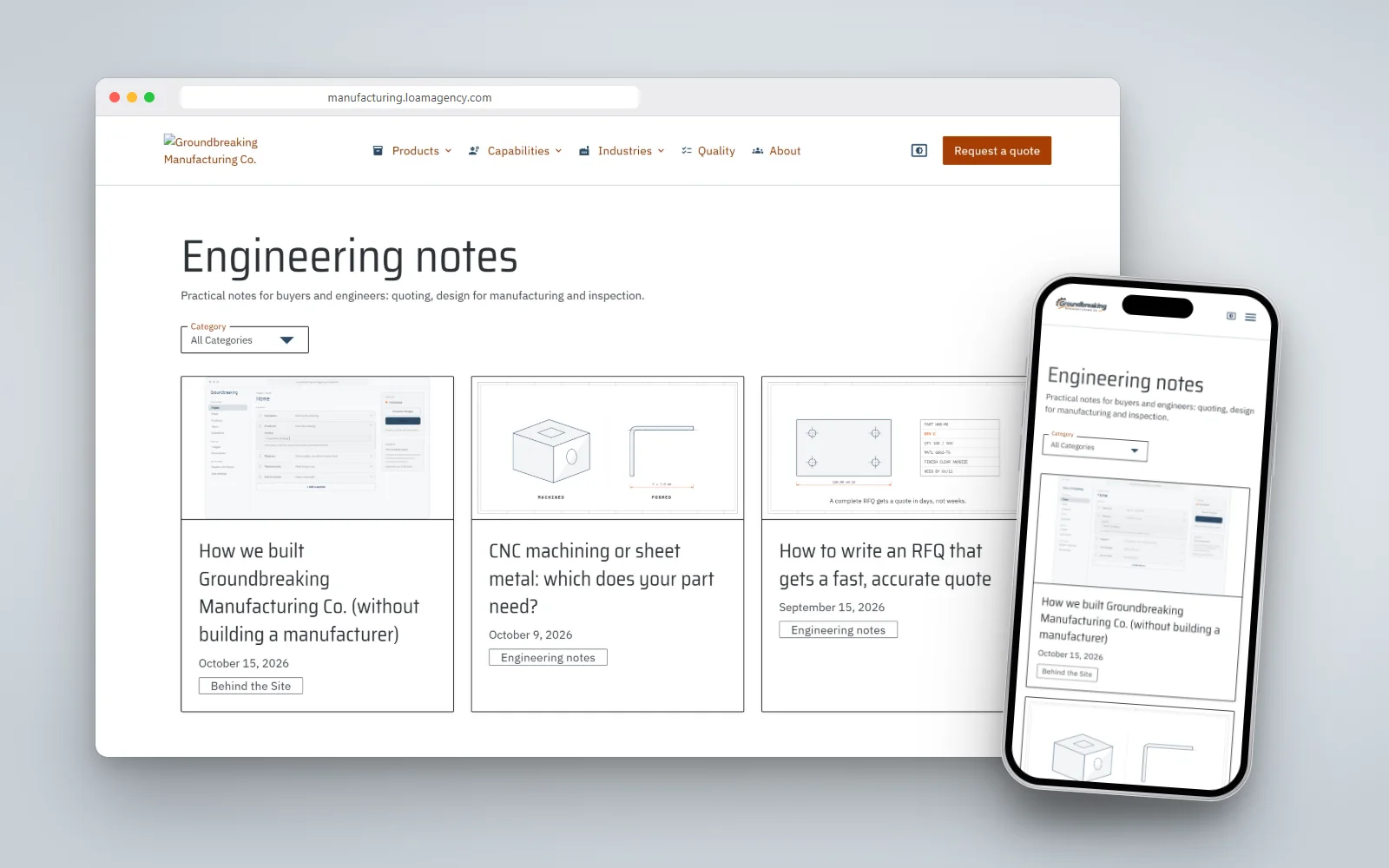
Quick answer: on Groundbreaking Manufacturing Co., a fictional contract manufacturer Loam built to show a manufacturer's website and technical articles in action.
Explore Groundbreaking Manufacturing Co. to see capability pages, a quote path and technical articles working together. The shop, its machines, its people and its customers are made up; the website, its editor and its blog are real. See the other industries in our custom website examples.
If your shop gets most of its work by referral and you would like engineers to find you on their own, talk to Loam about what your website could say.
Post Details
October 8, 2026