
Why does a financial advisory firm need a content strategy?
People choose an advisor they already trust. Clear, compliant articles are how a firm earns that trust before the first meeting.
Because most people choose an advisor long before they book a meeting, and they make that choice by reading. A family thinking about retirement, an heir sorting out an inheritance, an owner about to sell a business: each of them spends months quietly working out whom to trust. A content strategy is the plan that puts your firm's explanations in front of them during those months, in an order that matches the questions they actually have, with every word passed through the same compliance review as your other marketing.
Without a plan, a firm's articles tend to be a scatter of market commentary written when someone had a spare afternoon. With one, the site becomes a patient, well-organized answer to the handful of things every prospect needs to understand before they will hand over their savings: how you are paid, whether you act in their interest, what you would actually do for them, and what working with you feels like.
Why do prospects read for so long before they call an advisor?
Quick answer: because hiring an advisor means trusting a stranger with the money a family spent decades saving, and nobody does that on impulse.
The buying cycle in this industry is slow and usually starts with a life event: a parent dies, a spouse retires, a business sale closes, a company changes its pension plan. The person affected often does not call anyone for months. They read. They search the question that is keeping them up, they find three or four firms that answer it, and they read those firms' other articles to see whether the tone holds up.
Two things make this cycle different from most businesses. First, there is usually more than one decision-maker. A husband reads the fee article and forwards it to his wife; an adult daughter reads the article on helping aging parents and sends it to her brother. Your writing has to make sense to the person who did not find it. Second, many prospects already have an advisor and are quietly unhappy. They are comparing your plain explanation of fees against a statement they have never fully understood. Clear writing is the most persuasive thing you can offer them, because it shows them what being a client would feel like.
That is why the articles that matter most are not about markets. They are about the relationship: how it starts, what it costs, what you will and will not do.
Which questions should an advisory firm answer first?
Quick answer: the questions prospects are embarrassed to ask in a first meeting, starting with how you are paid and whether you are a fiduciary.
Listen to your own first meetings for a month and write down every question. Most firms find the list is short and repeats. The ones that come up in nearly every conversation deserve a full article each, written so well that a prospect could forward it to a skeptical relative.
A starting list for an independent firm:
- How do you get paid? A plain guide to your fee structure with a worked example in round, illustrative figures, and what is not included.
- Are you always a fiduciary? What the word means, when it applies to your firm and when it does not, written without hedging.
- When can I afford to retire? The three or four numbers that decide it, and why the answer changes from family to family.
- What should I do before December? A dated year-end checklist that you refresh every autumn.
- What happens in a first meeting? What to bring, what you will ask, how long it takes, and what happens afterward if they decide not to go ahead.
- How do I help my parents with money? How to start the conversation, which documents to look for, and when to bring in a professional.
Notice what is missing: predictions, stock picks, hot takes on the news. Those age badly, invite compliance trouble, and say little about whether you would be good to work with. Market notes have a place, but as plain explanations of what happened and what it does and does not mean for a long-term plan.
How often should a firm publish, and when?
Quick answer: two considered articles a month, timed to the calendar your clients already live by, is plenty for a small firm.
Advisory content is more seasonal than most firms realize. In the first months of the year people want help with tax paperwork and contribution limits. In spring and early summer, college savings and mid-year reviews. Late summer and autumn is when people start thinking about retirement dates and estate documents. And from October onwards, everyone wants the year-end checklist, charitable giving ideas and required distribution reminders.
The calendar also tells you what to refresh. Your fee explainer, first-meeting guide and retirement timing article are evergreen. Rather than writing new versions, update them once a year, change the review date at the top, and let them keep earning. A firm with twenty excellent, current articles is in a stronger position than one with two hundred dated posts nobody has looked at since they were approved.
Consistency matters more than volume here for a specific reason: compliance review takes time. A steady rhythm of two pieces a month gives your reviewer a predictable load. A burst of eight articles before a conference, followed by six silent months, clogs the review queue and tells returning readers the firm has lost interest.
What should the first 90 days look like for an advisory firm?
Quick answer: month one is listening and setting up review, month two is the two articles that explain the relationship, and month three is the first seasonal piece and a habit.
Month one: listen and set up the review path
- Keep a running list of every question asked in first meetings and client reviews.
- Agree with your compliance officer how articles will be submitted, who signs off, and how approval is kept on file.
- Write a standard disclosure for the foot of every post and get it approved once.
- Choose a named author for each article. Prospects want to know which advisor is talking.
Month two: publish the relationship articles
- Write and publish the fee explainer, with a worked example in illustrative numbers.
- Write and publish the first-meeting guide, including what happens if the prospect walks away.
- Link both from your services and contact pages, so a visitor who lands anywhere can find them.
Month three: the first seasonal piece and a habit
- Publish one article tied to the season you are in: the year-end checklist in autumn, contribution limits in winter.
- Draft the next two articles so the review queue is never empty.
- Ask every new prospect, in the first meeting, whether they read anything on the site first. Write the answer down.
By day 90 the firm has three or four articles that do real work, an approval process everyone understands, and the beginning of a habit. That is a better foundation than a launch-day batch of twenty posts.
How do you write one advisory article well?
Quick answer: open with the answer, explain the reasoning in plain words, show one worked example, and end by telling the reader what to do next.
Structure
Start with the question in the reader's words as your title, and answer it in the first paragraph. Then explain the reasoning: what affects the answer and why. A single worked example, using round illustrative figures and clearly labeled as hypothetical, does more than three paragraphs of theory. Close with the next step: a checklist, the documents to gather, or an invitation to a first meeting.
Length
Most strong advisory articles land somewhere between eight hundred and fifteen hundred words. Long enough to explain the trade-offs honestly, short enough that a busy reader finishes it. If a topic needs more, split it.
Who writes it
The advisor should own the substance, but does not need to type it. A good pattern is a twenty-minute conversation in which an advisor explains the topic out loud while someone takes notes or films it, followed by a draft written by an associate or an outside writer, then an edit by the advisor for accuracy and voice. That keeps the expert's time small and the article in the expert's words.
Review
Every article goes through compliance before publishing, and again when it is materially changed. Build that into the schedule rather than treating it as a hurdle at the end. Keep the approved version on file with the date.
What should a firm be careful about in its articles?
Quick answer: treat every article as advertising, keep it educational, and have it reviewed under the rules that apply to your firm before it goes live.
This section is general guidance, not legal or regulatory advice. The rules differ depending on how your firm is registered and which regulators oversee it, so confirm the specifics with your own compliance officer or counsel. Within those rules, a few habits keep a firm's blog on safe ground:
- No performance promises. Do not suggest a reader will get a particular return, avoid losses, or retire by a certain date if they hire you. Explain how decisions work, not what outcomes to expect.
- Check before using testimonials or client stories. Whether, and how, you may use testimonials, endorsements or reviews depends on the rules that apply to you. Ask before you publish one, even an anonymous one.
- Disclose clearly. Say at the foot of each article that it is general information, not personal advice, and include whatever disclosures your compliance officer requires.
- Date everything. Contribution limits, tax thresholds and rules change. Show the date an article was written or last reviewed, and refresh the numbers when they change.
- Keep hypothetical examples obviously hypothetical. Label them, use round numbers, and avoid anything that looks like a real client's situation.
- Keep approvals on file. If someone asks later what was published and when, you should be able to show the approved version.
None of this makes writing harder once it is a habit. Clients often find the disclosure reassuring: it signals a firm that takes its obligations seriously.
How can a firm tell whether the articles are bringing in clients?
Quick answer: count the first meetings where the prospect mentions an article, and watch which pages people read before they get in touch.
Advisory sales cycles are long, so the measures that matter are slow. Ignore daily traffic swings. Look instead at a handful of signals, monthly:
- Mentions in first meetings. The single most useful measure. Ask, and keep a simple tally of which articles prospects name.
- Reading paths before contact. In your site analytics, look at which articles were viewed in the visits that ended on your contact page.
- Searches for the questions you answered. Google Search Console shows which search phrases bring people to each article. If "how are fee-only advisors paid" starts appearing, the fee explainer is being found.
- Time on your fee and process pages. People who read these slowly are often serious.
- Forwarded links. If a prospect arrives saying their spouse sent them an article, note it. That is the two-decision-maker cycle working.
Ignore follower counts and likes on social posts about markets. They rarely correlate with meetings for an advisory firm.
What mistakes do advisory firms make with content?
Quick answer: writing about markets instead of the relationship, publishing in bursts, and letting dated articles sit unreviewed.
- Commentary instead of explanation. A weekly market recap is easy to write and says little about what you would do for a family. The fee and first-meeting articles are harder to write and far more persuasive.
- Vague fee language. Prospects can tell when a firm is avoiding the question. A worked example, approved by compliance, builds more trust than a paragraph of reassurance.
- Buying generic articles. Syndicated pieces written for thousands of firms read that way, and they do nothing to show a prospect what your advisors sound like.
- Bursts and silences. Eight posts in one month and none for the next six leaves the review queue jammed and the blog looking abandoned.
- Stale numbers. Last year's contribution limit in an article dated this year undermines every other page.
- No author. An article signed "the team" wastes the chance to introduce an advisor before the meeting.
What should a firm ask a web team before hiring one?
Quick answer: ask how the firm will publish, review and update articles without them, and how the site handles the information prospects send.
A website for an advisory firm is mostly a publishing system with a contact form attached. These questions separate a team that understands that from one that does not:
- Can our staff write, save drafts and preview an article before publishing, without calling you? You want an editor with drafts, live preview and a history of changes.
- How will our compliance reviewer see exactly what will go live? A preview of the finished page is better than a document that gets reformatted later.
- How do we update an evergreen article each year without breaking its address? The fee explainer should keep the same link for years.
- Will each article be marked up so search engines and AI assistants can read it? Ask about structured data, meta descriptions and a sitemap that updates when something is published.
- What happens to the information people send through our forms? Ask about spam protection, where messages go, and what the form invites people to share. A contact form should not encourage prospects to type account details.
- Who looks after security and updates after launch, and how will we hear about it? A monthly review with a plain report is the standard to ask for.
- Can you show us a working site, not just screenshots? A live site, editor included, tells you more than a portfolio.
Where can you see an advisory firm's articles working?
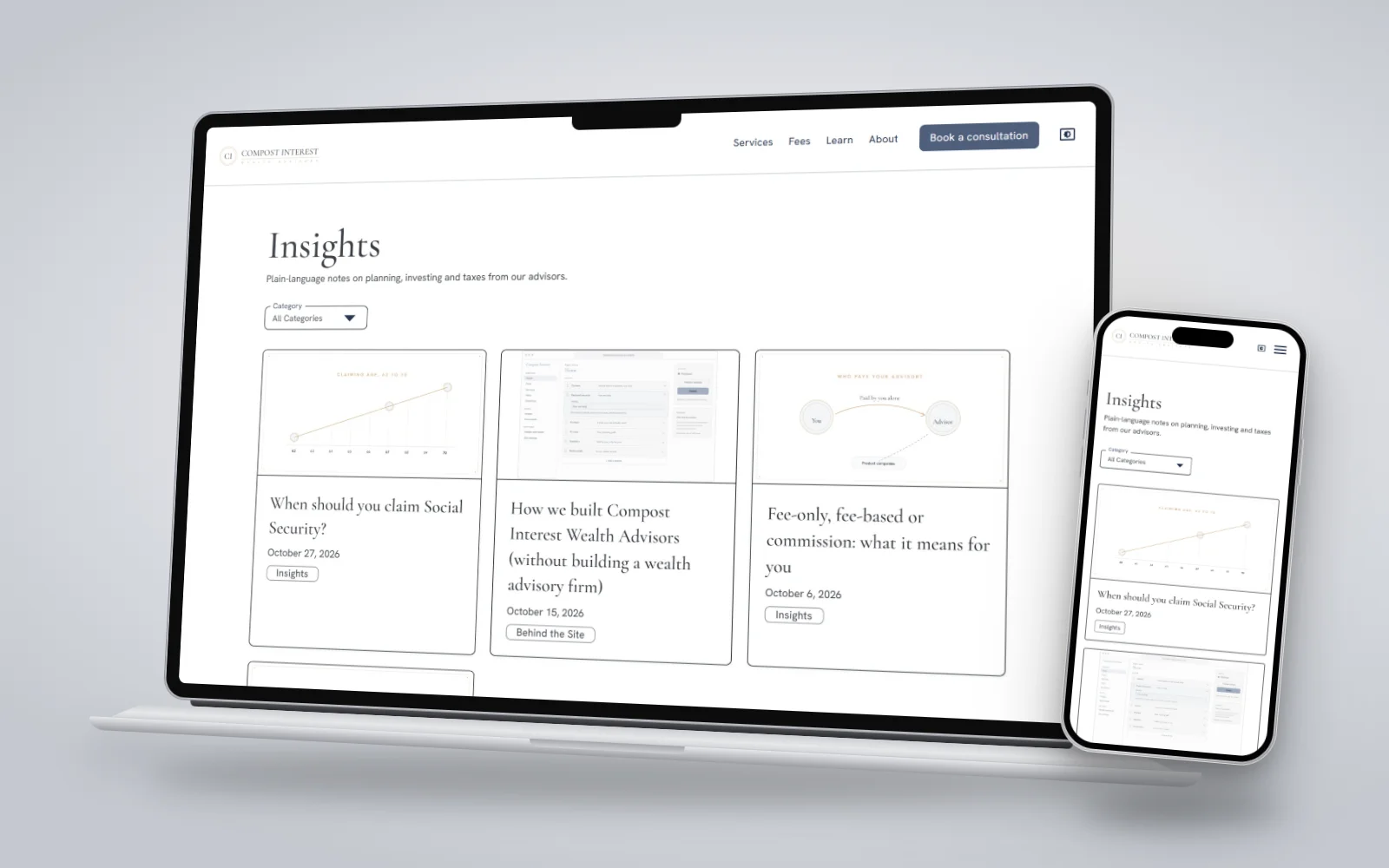
Quick answer: on Compost Interest Wealth Advisors, a fictional wealth advisory firm Loam built so you can see the whole site, blog included.
The firm, its advisors and its clients are invented. The website, its editor and its articles are real and working, so you can see how a fee explainer, a first-meeting guide and a seasonal checklist sit together. For how this fits into the wider case for publishing, read about why an advisory firm in particular needs a blog, one of ten industries we look at side by side. You can also browse every example site we have built.
If you would like a site like this for your own firm, with a review path your compliance officer is comfortable with, tell us about your firm.
Post Details
July 1, 2026