
Why does a capital partner need a content strategy?
Owners, employees and boards look you up before they talk to you. Plain articles on how you own companies answer the questions they are afraid to ask.
Because the people who matter most to a firm that owns companies are making up their minds without you in the room. An owner deciding whom to sell to reads your website late at night, long before telling anyone the business might be for sale. The people who work there read it the week the sale is announced. A candidate for chief executive reads it before taking the call. A content strategy is the plan for answering all of them in writing, plainly and consistently, with your counsel reading every word before it goes up.
Most firms in this business publish very little: a page of logos, a page of portraits and a paragraph about partnership. Readers fill that silence with whatever they have already heard about buyouts. A firm that explains how it buys, what it changes, what it charges and how ownership ends gives them something better to judge it on. And because you own companies, the same thinking applies twice, since every business in the portfolio has its own customers, its own applicants and its own questions to answer.
Who reads a capital partner's website?
Quick answer: owners thinking about a sale, the people inside companies you own or might own, boards and lenders, and investors, each with a different question and a different reason to doubt you.
It helps to write down what each of them is worried about, because the worries are what you are answering.
- Owners and founders. Many sell a company once in their lives. They are weighing a price against a name on a building, a management team they trained, and a town that will ask them about it afterward. They rarely call first. They read several firms, quietly, and compare what each one is willing to say.
- Employees of portfolio companies. On the day of an announcement they search your name on a phone. They want to know whether their job, their pay, their benefits and their manager are safe, and they notice evasions at once.
- Executives and operators you hope to hire. They want to know who decides what, how often a partner calls, and what a difficult quarter is like.
- Boards, lenders and advisers to sellers. Intermediaries put forward buyers they can describe. A lawyer, banker or accountant who has read your explanation of the process can repeat it to a client.
- Investors, present and prospective. They read for consistency and care. What you may say to them, and where, is governed by rules we come to below, and a public article is usually the wrong place for it.
One article can serve several of these readers if it answers honestly. An explanation of your first hundred days reassures an owner, steadies an employee and tells a candidate how you behave.
Which questions should a firm answer first?
Quick answer: the ones sellers and employees ask when the door is closed, starting with what changes after a sale and what happens to the people.
Ask your deal team, your operating partners and the human resources leads at your companies for the questions they dread. Those are your topics.
- What do you do in the first 100 days? What changes after a sale and what does not, described as a sequence: who visits, what is reviewed, what is left alone, when decisions get made.
- What happens to our people? Jobs, pay, benefits and who decides. Write what you commit to, what you cannot promise, and how you tell people when something does change.
- How long do you hold companies? How ownership can end, what usually prompts it, who hears first, and what happens to promises made at the start.
- How much debt will it carry? How a purchase is paid for, in plain words, what borrowing means for the company's room to invest, and how you decide the limit.
- What do you charge your companies? Every kind of fee a company might pay its owner, what it buys, and which ones you do not charge.
- What does a board see each month? The monthly report, figure by figure, with the people figures beside the money.
After these come the pieces only you can write: what you look for and what you decline, how a family owner can keep a stake, how a management team takes part, what a good handover looks like, and the questions a seller should ask any buyer, including you. That last one is worth doing early. A firm that arms the other side with hard questions has said a great deal about how it expects to answer them.
Why candor is the strategy
Every firm says it partners with management. Few say what a partner can overrule. Where you can state a rule, state it, along with the exceptions. If something differs from company to company, say that it differs and describe what decides it. Vague warmth is read by a careful owner as a clause they have not found yet.
Why does each portfolio company need its own website and articles?
Quick answer: because its customers, applicants and suppliers are different people from yours, searching for different things, and your site cannot answer them.
A components maker needs capability guides for engineers. A home health company needs pages for families and for nurses looking for shifts. A food business needs to explain its ingredients to buyers for grocery chains. None of those readers has any interest in who owns the company, and all of them are deciding whether to call.
A portfolio is a good place to do this well, because the standard can be shared while the voice is not:
- Share the standard. Agree one level of security, accessibility, speed, privacy and upkeep across every company's site, with a named person responsible for each and a regular report to the board.
- Keep the brand and the domain with the company. If you sell the business one day, its website, its articles and its search standing should leave with it, with nothing to untangle.
- Let the people who do the work write. A foreman, a nurse manager or a head of service knows which questions come in. The firm can fund an editor. It should not supply the opinions.
- Measure it the same way everywhere. Inquiries, applications and repeat questions are easier to discuss at a board meeting when each company counts them alike.
- Treat content as an asset you are building. An acquired company often arrives with an aging site and no articles. Planning the replacement in the first year, at a pace the team can manage, is ordinary stewardship.
Link from your own portfolio page to each company's site, and let each company page say what it does in a sentence its customers would recognize.
How often should a firm publish, and when?
Quick answer: one carefully reviewed article a month from the firm, and one or two from each company, following its own season.
Review takes time here, so a modest rhythm you can keep is better than a rush before a conference. The firm's calendar follows how owners and boards spend their year.
- Winter: an owner's guide to a sale, a guide to board reporting, and a refresh of the page that says how you own companies.
- Spring: the first hundred days, an approved story from one company, and answers to the questions employees ask.
- Summer: succession planning, an operating note from a company, and what lenders ask for.
- Autumn: budget season for boards, hiring and promotions across the companies, and a year in review.
Some of your most important writing is never scheduled. When a purchase or sale is announced, have a plain page ready for the people affected: what is happening, what is not, whom to ask, and when they will hear more. Prepare the format in a quiet month and have counsel agree it in advance.
What should the first 90 days look like?
Quick answer: settle the review path and what you may say, publish two articles for owners, then one for employees, and begin with one portfolio company as a pilot.
Days one to thirty: agree the rules
- Meet your counsel and your compliance lead before anyone drafts. Decide which subjects are open, which need review every time, and which are off the table.
- Write the standing disclosures once and have them approved.
- Collect questions from sellers, managers and employees, with names removed.
- Choose who speaks for the firm on each subject, and put real names on articles.
Days thirty-one to sixty: write for owners
- Publish the first hundred days, checked against what happened the last few times.
- Publish the questions to ask any buyer.
- Put both one click from the page an owner would use to contact you.
Days sixty-one to ninety: write for people, and start a pilot
- Publish the employee page, reviewed by counsel and by the human resources lead of a company that has been through it.
- Pick one portfolio company whose team is willing, list its customers' questions, and publish its first two answers on its own site.
- Set a date to review every page on both sites, and write it in the board calendar.
The point of the quarter is a working review path and proof that it produces something worth reading.
How do you write one article well?
Quick answer: open with a direct answer, state the rule and its exceptions, use an invented example labeled as one, and end with whom to ask.
- Use the reader's words. "Will I lose my job if my company is sold" is what gets searched.
- Answer in the first paragraph, including the part they may not like.
- Explain the mechanism. A short sequence of who does what, and when, is worth more than adjectives.
- Define finance terms once. Covenant, earnout, rollover and working capital mean nothing to most of the people affected by them.
- Keep examples invented, and say so. Use round, hypothetical figures for a made-up company. Never disguise a real one thinly.
- Have an operator read it. If the chief executive of a company you own would wince, find out why before anyone else does.
- Send it through review, and keep the approved version with its date.
Length depends on the question. An owner weighing the largest decision of a career will read a long guide to the end. An employee on a break will not, so give that page short paragraphs and clear headings.
What does a capital partner need to be careful about?
Quick answer: keep articles educational, make no claim about performance, offer nothing for investment, protect confidential information, and have qualified counsel review everything before it is published.
Nothing in this article is investment advice, legal advice, an offer of any security or a statement about returns, and your own articles should be able to say the same.
- Fund marketing is regulated. What an adviser or fund may say in public, to whom, and with which disclosures depends on where you are and how you are registered. Some private offerings may not be promoted to the general public at all, and a careless sentence on a website can cause real trouble. Counsel decides where the line is, not a marketing team and not a web agency.
- Leave performance out. Returns, rankings, projected growth and selected success stories each carry rules about fair presentation. An article about how you work does not need them.
- Ask before quoting anyone. Statements from sellers, executives, employees or investors may count as testimonials or endorsements. Have each one cleared, along with any relationship that must be disclosed.
- Choose examples fairly. Writing only about the companies that went well can mislead, even when each sentence is true.
- Guard confidential information. Deals under discussion, lender terms, board papers and company results stay private unless every party has agreed. If any company has publicly traded securities, extra rules apply to what is said and when.
- Take care with promises to employees. A sentence about jobs or benefits can be read as a commitment. Employment counsel should check it.
- Keep dates and disclosures visible. Say when a page was reviewed, that it is general information, and where the full disclosures are.
A reader who sees a careful firm being careful in public learns something useful about it.
How will you know it is working?
Quick answer: listen for owners and candidates who arrive already understanding how you work, and watch the same few signs at each company.
Traffic to a firm's site is usually small, and a single right reader can matter for years. Look for these:
- First calls that start further along. Note when an owner or adviser mentions something they read, and which page it was.
- Better matched introductions. If your article about what you decline is clear, fewer unsuitable proposals arrive.
- Questions after an announcement. Compare what employees asked before the employee page existed with what they ask now.
- Candidates who quote you. An executive who read about your board reporting comes to the interview with sharper questions.
- Company signals. For each portfolio company, count inquiries, applications and quote requests that began on an article, and report them beside the other figures the board sees.
Do not count likes, and do not read anything into one month.
What mistakes do firms like yours make with content?
Quick answer: writing only for other dealmakers, hiding behind adjectives, announcing without explaining, and leaving their companies' websites to age.
- Announcements as a blog. A list of closings tells an owner you buy things. It does not say what selling to you is like.
- The vocabulary of the trade. "Value creation levers" reads to an employee as a threat.
- One voice for every company. Near-identical sites across a portfolio look efficient to the owner and hollow to the customer.
- Market predictions. They date quickly, invite compliance questions and help no one choose a buyer.
- Silence when it counts. The week after an announcement is when people search. An empty page that week is an answer of its own.
- Pages nobody owns. A partner who left, a company that was sold and a fund page out of date are all small signs that nobody is checking.
What should a firm ask a web team before hiring one?
Quick answer: ask how review and approval work inside the editor, how private reporting is kept apart from the public site, and how each company's site can stand on its own.
- Can counsel preview the finished page and approve it before anyone can see it? A document sent by email is not the page.
- Is there a history of what was published and when? You should be able to show any earlier version.
- If we offer reporting to boards or companies, how is access decided? It should be checked for each person and each company, on every figure, with sign-in separate from the website's editors.
- Can a portfolio company's site be handed over cleanly if we sell the business? Ask who holds the domain, the hosting and the content.
- How will you keep several sites to one standard? Expect a written one, with regular security, accessibility and performance checks and a report a board can read.
- Do charts come with a table and work for a screen reader? Boards print things, and not everyone sees color the same way.
- Will you refuse to publish something counsel has not cleared? The right answer is yes.
Where can you see this working?
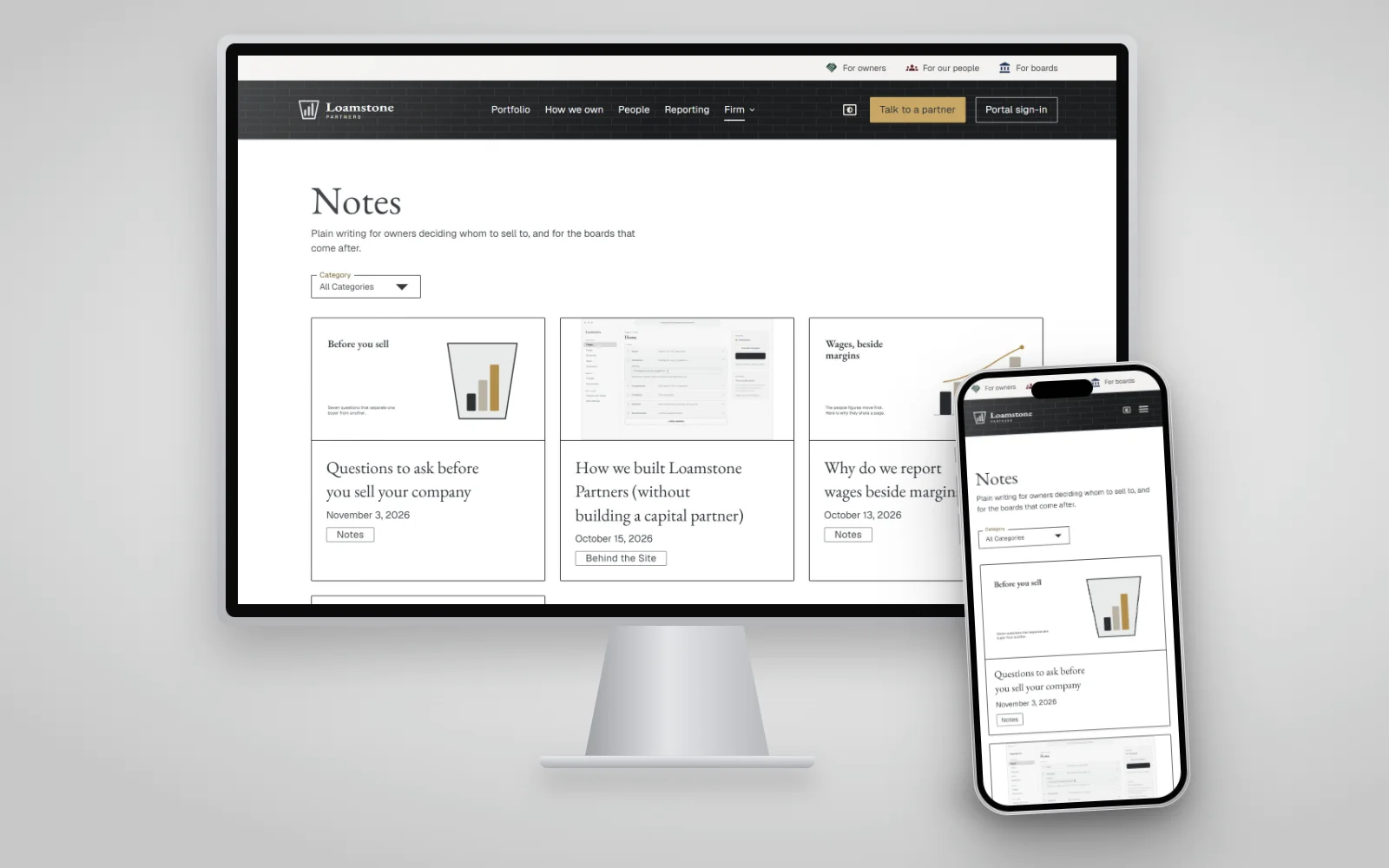
Quick answer: on Loamstone Partners, a fictional long-term owner of companies that Loam built to show a whole site, notes for owners and a company reporting portal included.
There is no fund, there are no companies and nothing is for sale: the firm, its people, its portfolio and every figure are invented, and its disclosures page says so. The website, its charts and the demo portal are real, so you can see how a page for owners, a page about people and a monthly report fit together, and how a person signing in sees only the companies they are assigned. Our overview explains briefly why capital partners need a blog alongside eleven other industries, and every other example website is there to compare.
If you own companies and would like your site, or theirs, to answer the questions people are already asking, talk to Loam.
Post Details
November 20, 2026