
Why does a bookstore need a content strategy?
Readers come to an independent bookstore for taste. Articles carry that taste to the people searching for their next book, all week long.
Because the thing that makes an independent bookstore worth the trip is invisible from the street. Anyone can sell a given book. What only you have is the bookseller who read it last weekend and knows which regular will love it, the shelf of local authors nobody else carries, and the folding chairs that come out when a writer visits. A content strategy is a plan for putting that judgment where readers go looking for their next book: on your website, written by your staff, kept current all year.
It does not need to be grand. A bookstore that publishes a short staff pick most weeks, explains how special orders and trade-ins work, and posts its events before and after they happen has a content strategy. The rest of this article is about doing that on purpose, so it keeps happening after the first enthusiastic month.
When does a reader actually decide what to buy?
Quick answer: usually at home, late in the evening, a few days before they walk in. The shop that has already answered "what should I read next?" is the one they walk into.
The buying cycle in a bookstore is short and constant. A reader finishes a novel on Tuesday night and starts looking for the next one before they put the light out. Someone hears about a memoir on the radio and wants it by the weekend. A grandparent needs a picture book for a birthday on Saturday. None of those moments happen while your door is open, and most of them start with a search or a scroll.
Then there are the slower, bigger cycles that repeat every year: the holiday gift rush, summer reading lists from the schools, book clubs choosing their autumn titles. Those are planned purchases, and the people making them look for advice weeks ahead.
Social posts help with the short cycle for a day, then sink. A page on your own website keeps working: the staff pick from March still answers "something like that novel everyone's talking about" in June. That difference, a post that disappears versus a page that stays findable, is why the website is the home for your best recommendations and the social accounts are where you point people to them. We make the same case for nine other kinds of business in our article on why every business needs a blog, and bookstores have the easiest version of it, because recommending things is already the job.
What do readers ask a bookstore before they come in?
Quick answer: four questions come up again and again: what should I read next, can you order a book for me, do you buy used books, and when is the next author event. Each one deserves its own page.
Listen at the counter for a week and write down every question that takes more than a sentence to answer. Most shops end up with a list like this:
- What should I read next, if I loved this one?
- Can you order a book you do not have, and how long will it take?
- Do you buy used books, and what do you take?
- When is the next author event, and do I need a ticket?
- What is a good gift for a reader I do not know well?
- What is my book club reading, and is there a discussion guide?
The first is answered by your recommendations, a little at a time. The rest are answered once, properly, and then kept up to date. The figure below pairs six of those questions with the article that answers each.
When the trade-in page says plainly what you take and how you pay, your staff stop explaining it over the phone ten times a week, and the people who arrive with a box of paperbacks have already sorted out the ones you will not want.
What should an independent bookstore publish?
Quick answer: the recommendations you already give across the counter, written down, plus a handful of plain pages on how your services work.
Here is a starting list, in the order most shops find useful:
- This month's staff picks, and why. One book per bookseller, each with a real reason: who it is for, what it reminded them of, where they read it.
- "If you loved…" lists. Take the three titles customers ask about most this season and suggest five books for each, from your shelves.
- How special orders work. What you can get, roughly how long it takes, how you let people know it has arrived, and whether they pay up front.
- Trade-ins: what we take and what we pay. Conditions, genres you are full on, days you buy, and whether it is store credit or cash.
- Book club picks with discussion questions. Write your own questions. Clubs come back for the questions as much as the book.
- Author events and how to get a seat. One page per event, published as soon as it is confirmed, with a recap afterward.
- Holiday gift lists by reader. Not "the best books of the year" but "for the dad who only reads history" and "for a nine-year-old who has finished every dragon series."
- The local shelf. Short profiles of the local authors you stock, which no national list will ever cover.
- Notes on new releases worth waiting for. A short post when a much-anticipated book is due, with a line on whether you are taking preorders.
Add reading lists for young readers by age if you have a strong children's section. Parents and teachers look for them constantly, and your bookseller can say which books suit a reluctant reader.
How often should a bookstore publish, and when?
Quick answer: a short post every week or two, with the bigger lists planned around the reading year: holidays, summer, back to school and book-club season.
Bookstore posts can be short. A good staff pick runs three or four hundred words. An event announcement is less. What matters is the rhythm, because readers who find a pick they love come back to see the next one, and a steady pace gives every bookseller a turn without anyone carrying the whole load.
The bigger pieces follow the seasons, and the trick is to publish them early. A holiday gift guide that goes up in mid-December arrives after most people have bought. A summer reading list belongs online when the schools send their lists home, not in July. Book clubs pick their autumn titles before the summer ends.
On the first of each quarter, sit down with your events calendar and the publishers' release dates, write that quarter's three seasonal titles at the top of a page, and fill in the weekly picks underneath as booksellers volunteer. Winter is reading lists, book club picks and event recaps; spring is new releases and graduation gifts; summer is beach reads and the autumn line-up; the last quarter is the gift guide and the staff's favorites of the year.
What does a bookstore's first 90 days look like?
Quick answer: spend the first month on the pages that answer service questions, the second building the staff-pick habit, and the third on an event and the next seasonal list.
Month one: the pages that save you phone calls
- Week one: write the special orders page. Ask whoever handles orders to list every question they hear and answer each one.
- Week two: write the trade-ins page, with what you take, what you are full on and when you buy.
- Week three: write a short page on events in general: how you announce them, whether seats are free, how to get on the list.
- Week four: write a gift cards page and a page about the shop itself, with a photo of the staff and a sentence from each.
Month two: the staff-pick habit
- Week five: ask every bookseller for one pick and a paragraph on why. Publish the first.
- Weeks six to eight: publish one pick a week. Put a printed card on the shelf beside each book saying the full review is on the website.
- At the end of the month, write one "if you loved…" list from the titles customers asked about most.
Month three: events and the season ahead
- Week nine: publish the page for your next event, with a date, a time and how to get a seat.
- Week ten: publish a book club pick with your own discussion questions, and tell the clubs that meet in the shop.
- Week eleven: hold the event, and write the recap within two days, while people still remember it.
- Week twelve: draft the next seasonal list, whichever one is coming up, so it goes up early.
By day ninety you will have a dozen pages that keep working and a habit the whole staff shares.
How do you write a staff pick or reading list that sells the book?
Quick answer: write for one reader, give a reason no publisher blurb would give, and keep it short enough to finish standing in the aisle.
The structure
- Who it is for. Open with the reader, not the plot: "For anyone who misses the long winter evenings of a big family saga."
- What it is, in two sentences. Enough to place it. Skip the plot summary on the back cover.
- Why you loved it. The part only you can write. Where you read it, what it made you think about, the moment you knew.
- What to read next. One or two books from your shelves that sit beside it.
- How to get it. Whether it is in stock, and if not, that you can order it.
Length and quotes
Three to five hundred words for a single pick. A reading list can run longer, with two or three sentences per book. If you quote the book, keep it to a line or two and name the author: a short quotation in a review is normal, pages of it are not yours to publish.
Who writes it and who checks it
The bookseller who loved the book writes it, in their own voice, with their name on it. Readers follow a person's taste, and a pick signed by the whole shop has no taste to follow. Someone else, usually the owner or manager, reads it before it goes up and checks four things: titles and author names spelled correctly, the edition you actually stock, nothing that gives away an ending, and that it still sounds like the person who wrote it.
How will you know whether the writing is selling books?
Quick answer: watch which lists turn into sales and event seats, and ask at the counter. Ignore likes and raw page counts.
The best measures for a bookstore are the ones you can see from behind the till:
- Special orders that name an article. When someone asks for a book "from your list," that list is working. Keep a tally on a notepad by the register for a month.
- Event sign-ups from event pages. If the event page is the main place people learn about a reading, the seats are the measure.
- Newsletter subscribers who arrive from reading lists. A list that grows your mailing list keeps paying off long after it was written.
- Searches that find you. Your website analytics show which searches bring people to which pages. Look for your shop's name, "bookstore near me" and the titles of your lists.
What to ignore: the number of likes a link gets, and big jumps in visits to one list from readers in other countries. A list that goes around online is pleasant, but people far away will not walk through your door. Look at the pages your neighbors read and the books they then buy.
What mistakes do bookstores make with their websites?
Quick answer: borrowing publishers' words, leaving event pages to go stale, hiding the service pages and publishing seasonal lists too late.
- Copying the publisher's blurb. It is the same text on every bookseller's site, and it tells readers nothing about your taste. Say why your bookseller chose it.
- Lists with no reasons. Twenty covers and no sentences is a catalog, not a recommendation. Five books with a reason each will sell more than twenty without.
- Event pages that never change. An event page still announcing a reading from last spring makes the shop look closed. Turn every event page into a recap afterward, with a photo and a line on what was said.
- Burying the practical pages. Special orders, trade-ins and gift cards are what people look for when they are ready to spend. Link them from the menu, not a footer nobody reads.
- Missing the season. A gift guide in the third week of December, a summer list in August. Plan backwards from when people buy.
- One voice for the whole shop. If only the owner writes, the staff's taste never reaches the website, and the owner runs out of time by March.
- Sending readers elsewhere to buy. Every title link should lead to your own shop: your order page, your phone number or your address. A recommendation that ends somewhere else sells the book for someone else.
What should a bookstore ask a web team before hiring one?
Quick answer: ask whether your booksellers can publish on their own, how events are handled before and after the date, and who owns what you write.
These questions separate a team that understands a shop from one that will hand you a brochure:
- Can a bookseller write and publish a staff pick without calling you? Ask to see the editor. On a good site it is plain fields, a preview and a publish button, and a draft stays a draft until someone publishes it.
- Can a manager review a pick before it goes live? Drafts and a live preview make that easy. Ask how it works on their sites.
- How are events shown before and after they happen? Upcoming events should be easy to find, and a past event should not keep sitting at the top of the page.
- Can each article carry the bookseller's name and a link to their other picks? Readers follow a person's taste. The site should let them.
- Will the site tell search engines what each page is? Ask whether articles, events and frequently asked questions are marked up so search engines and AI assistants can read them.
- Who owns the content if we part ways? The answer should be you, all of it, without a fight.
- Who looks after the site after launch? Updates, security and the odd broken link need an owner. Ask who that is and how you reach them.
Where can you see a bookstore website like this working?
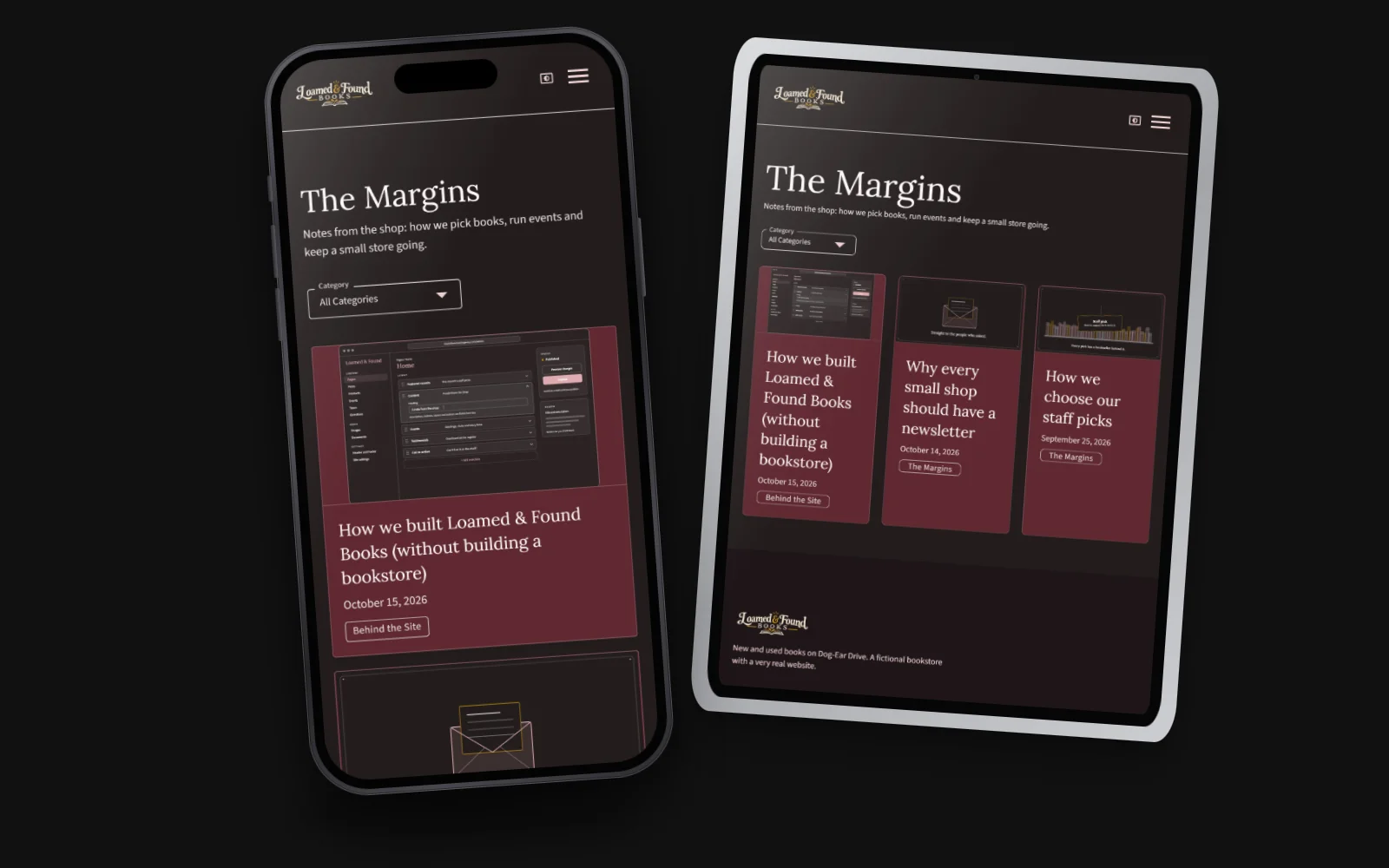
Quick answer: visit Loamed & Found Books, a fictional bookstore Loam built to show what an independent bookstore's website can do, articles and events included.
The shop, its staff, its titles and its reviews are invented. The website is real: its editor, its blog, its event pages and its forms all work, and they are built the same way as the sites we make for real businesses. Open a staff pick and picture your booksellers' names on it.
You can browse the other fictional businesses in our custom website examples to see how the same thinking fits a bakery, a spa or a landscaper. If you run an independent bookstore and want your shop's taste to be findable on a Tuesday night, tell us about your shop. We will start with the questions your customers ask at the counter.
Post Details
September 15, 2026