
Why does a bakery need a content strategy?
A bakery sells to people nearby and hungry. Articles bring in the ones a little farther away, planning a cake, a class or a Saturday visit.
A bakery needs a content strategy because the orders that keep it steady are decided at a kitchen table, not at your counter. Birthday cakes, wedding tiers, office breakfasts, holiday pies and Saturday bread classes are chosen days or weeks ahead by someone on a phone, asking the questions you already answer twenty times a week: how far ahead do I order, what will it cost, when does the sourdough sell out, is anything safe for my son with a nut allergy.
A content strategy is deciding which of those answers to write down, when to publish each one in the baking year, and how to tell whether they bring in orders. For most bakeries it is a dozen honest articles in the voice of the person who runs the ovens, so that when someone searches for a custom cake in your town in November, the page they find is yours.
Who is actually reading a bakery's articles?
Quick answer: Mostly planners, not passers-by: people ordering for a date, comparing two or three bakeries on a phone, and deciding quickly whether yours feels trustworthy.
Nobody needs an article to buy a croissant they can smell from the pavement. The articles are for everything that has to be arranged, and four readers want different things from them.
The occasion planner
A parent planning a seventh birthday, a couple three months from their wedding. They need your lead time, sizes, flavours, a starting price and how pickup works. Their deadline becomes yours, so the earlier they find a clear answer, the calmer your week.
The regular who wants more
They already love your rye. They want to know which mornings it is baked and whether you ever teach anyone to make it. Articles turn them into a class booking or a standing weekend order.
The careful eater
Someone with coeliac disease, a parent of a child with a nut allergy, a vegan friend buying for a dinner party. They read every word, and they decide on trust. A vague answer loses them; a precise, honest one keeps them even when the answer is that you cannot help.
The office manager
They book breakfast for a team meeting. They want a menu, quantities in plain terms, delivery times and invoicing, and they reorder from whichever bakery makes it easy.
What should a bakery write about first?
Quick answer: The six questions you hear most at the counter, each turned into one article with the details a customer needs to act: cake lead times, the morning bake schedule, allergens, how your bread is made, classes and catering.
Start with the questions that cost you the most time or orders when they go unanswered:
- Custom cakes: lead times, sizes and prices. Say how many days' notice you need for a simple cake and for a tiered one, which sizes feed how many guests, which flavours are always available and which are seasonal, and a real starting price. "Price on request" for everything sends people to the bakery that was willing to say.
- Our morning bake schedule, day by day. What comes out of the oven when, which loaves are baked only on certain days, and roughly when the popular ones tend to go. This one article saves your staff the same phone call every morning.
- Allergens and what our kitchen can promise. The most important page on the site for some customers, covered in its own section below.
- How we make our bread, step by step. Why the sourdough takes two days and what the starter is. This article explains what people are paying for.
- Classes, dates and what to bring. What each class covers, how long it lasts, whether beginners are welcome, what students take home, and what to wear.
- Office breakfasts and event platters. What is on the menu, how much notice you need, delivery hours and how ordering works.
After those six, add the pieces that make your bakery yours: the farm your flour comes from, the early shift, a bake your grandmother taught you. They come second, because a customer who cannot find your cake lead time never reaches the story about your flour.
What can a bakery honestly say about allergens?
Quick answer: Say exactly what is in your kitchen and how you handle it, and never promise that a bake is "free from" an ingredient unless your kitchen can truly keep that ingredient out, which most shared kitchens cannot.
This section is general guidance, not legal advice. Allergen labeling rules differ between countries, states and even towns, and some words, "gluten-free" among them, can carry a legal meaning where you trade. Check with your local food safety authority or environmental health officer before you publish anything that sounds like a promise.
A careful allergen article usually covers:
- The allergens present in your kitchen, not only in each recipe. Flour hangs in the air, nuts share a bench with the plain croissants, and sesame travels. List what is on the premises.
- How cross-contact can happen. Shared ovens, shared trays, shared mixers, a display case where loaves sit side by side, tongs that serve everything. Say it plainly so the reader can judge their own risk.
- What you can genuinely offer. Perhaps a bake made without wheat on a particular morning before the main production starts, sealed packaging for certain items, or a full ingredient list for any product on request. Offer only what you do every single time.
- What you cannot promise. "Made without nuts, in a kitchen that uses nuts" is honest. "Nut-free" usually is not.
- Who to ask in the shop. Tell customers that staff will check the written ingredient sheet rather than answer from memory, and make sure that is true on a busy Saturday with a new hire on the till.
- When the article was last checked. A supplier changes a chocolate, a recipe gains a nut topping, and last spring's article is now wrong. Put the date of the last review on the page and look at it whenever an ingredient changes.
Avoid medical language. Do not say a bake is "safe for coeliacs" or "suitable for allergy sufferers". Say what is in it and how it is made, and let people decide with their own doctor. The honest version earns the trust of the customers who read most carefully, and they tell each other.
When should a bakery publish, and how often?
Quick answer: Two articles a month suits most kitchens, but timing matters more than volume: publish each seasonal piece four to six weeks before the orders it is meant to bring in.
Your articles should arrive just ahead of each wave in the baking year.
- Winter. Valentine's orders, wedding cake planning for couples who got engaged over the holidays, and the dates for the new season of bread classes. January is quiet in the shop, which makes it the best month to write.
- Spring. Spring fruit bakes as rhubarb and berries arrive, graduation cakes, and your summer hours if they change.
- Summer. Picnic and party platters, back-to-school snacks for lunchboxes, and, earlier than feels natural, your holiday order dates. People who plan the holidays carefully start looking in late summer.
- Autumn and the holidays. The full holiday menu, gift boxes for clients and teachers, and the classes that start in the new year, so they make good presents.
Alongside the seasonal pieces, keep the evergreen ones current. Every January, reread the custom cake article and the catering menu and update anything that has changed over the year.
If two a month is too much before the holidays, write in the slow weeks and schedule ahead. A bakery that writes its October articles in August has a calm October.
What does a bakery's first 90 days of content look like?
Quick answer: Spend the first month writing the three answers people need before they can order, the second month on the pieces that build trust, and the third on your first seasonal article and a habit of checking what works.
Weeks 1 and 2: listen at the counter
Keep a notepad by the till and the phone, and write down every question customers ask, word for word, for two weeks. That list beats anything a marketer could guess.
Weeks 3 and 4: the ordering answers
Write the custom cake article and the morning bake schedule. These two are the ones most likely to save you phone calls and win orders straight away. Link the cake article to your order form or phone number so a reader can act the moment they decide.
Weeks 5 and 6: allergens
Write the allergen article slowly. Have whoever manages ingredients and suppliers check every line against the actual ingredient sheets, and check any legal wording with your local food authority before it goes live.
Weeks 7 to 10: how you bake, and catering
Write the bread article with photos taken on a real morning: the starter, the shaping, the cooling racks. Then write the catering article and send the link to every business that has ever ordered from you.
Weeks 11 to 13: the first seasonal piece and the first look back
Write the next seasonal article on the calendar and publish it a month early. Then spend half an hour on what people mention at the counter and what nobody has noticed, and decide what to write next.
How do you write one bakery article well?
Quick answer: Answer the question in the first two sentences, give the details someone needs to place an order, write it in the baker's own voice, and use photographs from your own kitchen.
A good structure for almost every bakery article:
- The answer first. "We need at least a week's notice for most custom cakes, and longer for tiered wedding cakes." The reader came for that sentence.
- The details that change the answer. Sizes, decorations that take longer, weekends that book up.
- Your own photographs. The actual cakes you have made, on your actual counter.
- What to do next. The order form, the phone number, pickup hours, where to park. Never end an article without telling the reader how to buy.
Length depends on the question. A bake schedule can be short and useful. A custom cake guide or an allergen article deserves more, perhaps six hundred to a thousand words, because the reader is about to spend money or trust you with their health.
The best writer is the person with flour on their apron, who rarely has time to type. So the head baker answers the question into a phone voice memo, someone at the front of house turns it into a draft, and the baker reads it aloud, cutting anything they would never say.
Before it goes live, one person checks the facts and another reads it on a phone as a customer would, looking for the one thing they would still need to ask. Drafts and live preview let you do this before publishing, not after.
How do you know the articles are working?
Quick answer: Look for orders and questions that trace back to an article, such as custom cake requests, class bookings and searches for your bakes by name, and give each piece a full season before you judge it.
Things worth watching:
- Custom cake and catering enquiries that came from an article page. Ask your web team whether your enquiry form can tell you which page it was sent from.
- Searches for your bakes and your town. A free tool such as Google Search Console shows which searches led people to your site. Seeing your signature loaf's name or "custom cake" with your town in that list is a good sign.
- Class sign-ups in the weeks after a bread article. The bread article is often how a regular discovers that you teach.
- Fewer repeat phone calls. Tally them for a fortnight before and after the bake schedule goes up.
- Customers who say they read it first. "I saw on your website that you need a week" is the most useful sentence you will hear at the counter. Ask staff to note it.
Things not to chase: likes on their own, a burst of visitors from a recipe that traveled far beyond your town, and daily traffic numbers. A bakery serves the people who can reach it, and a few local readers who order beat a distant crowd who never will.
What mistakes do bakeries make with their websites and articles?
Quick answer: Out-of-date hours and menus, holiday order dates announced too late, vague allergen promises, stock photos, and writing for other bakers instead of for customers.
The ones we see most often:
- The menu from two summers ago. Nobody forgives ordering a cake you stopped making.
- Holiday order deadlines posted only on social media, the week before. By then the planners have ordered elsewhere. Publish the dates on your own site in late summer and point everything else at that page.
- "Price on request" for every cake. A starting price filters out the wrong enquiries and reassures the right ones.
- Photos of cakes you never made. If the picture is not your work, the customer is buying a promise you have not kept yet.
- Allergen claims the kitchen cannot keep. This is the one mistake that can hurt someone. Be precise and modest.
- A menu that is a scanned document. Hard to read on a phone and invisible to search engines. Put it on the page as text.
- Writing for other bakers. Hydration ratios are lovely, but customers want to know when the loaf is ready.
- Letting the articles stop in October, just when they do the most work.
What should a bakery ask a web team before hiring one?
Quick answer: Ask whether you can change hours, menus and prices yourself in minutes, how you will publish seasonal articles on time, how enquiry forms reach you, and who looks after the site once it is live.
Questions that separate a good team from a poor one:
- Can I change the opening hours, the seasonal menu and cake prices myself, without filing a request? A good team shows you in the meeting.
- Can I write the holiday article in August, preview it, and publish it when I choose? Drafts and scheduling matter to a seasonal business.
- Will each article have its own clear title and description in search results, and the markup that helps search engines and AI assistants understand it? Listen for a plain answer. Be wary of anyone who promises a ranking; nobody honest can.
- Where do cake and catering enquiries go, and how is spam kept out? You want them in the right inbox, not lost among junk.
- How will large cake photos load on a phone? A slow gallery costs orders.
- If I ever leave, do my articles and photos come with me? The answer should be yes, without a fight.
- Who keeps the site secure and up to date after launch, and will I hear what was done? A website is not finished when it goes live.
A team that answers with specifics, and asks about your busiest seasons before talking about design, understands that a bakery's website exists to take orders.
Where can you see a bakery website like this working?
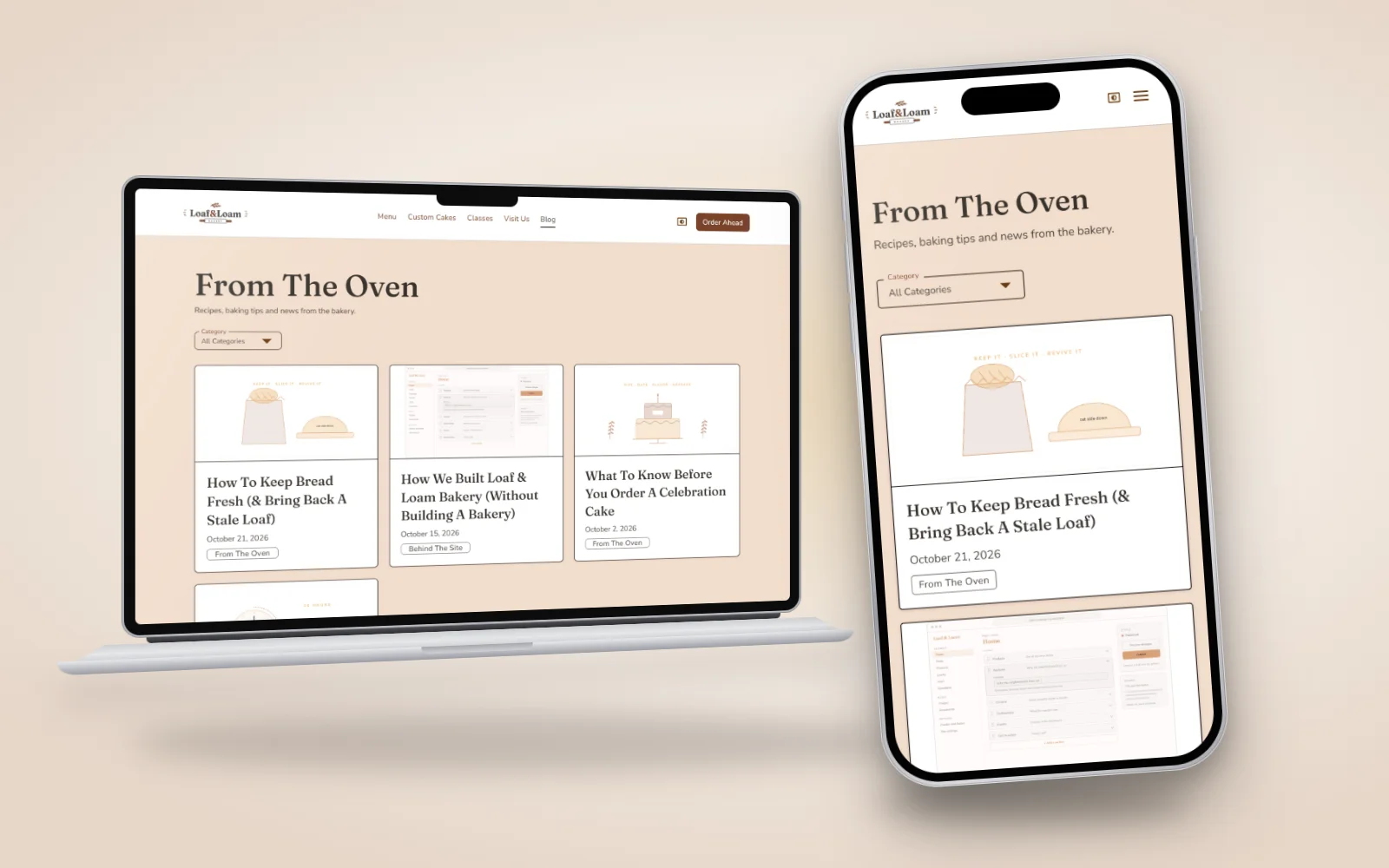
Quick answer: Loaf & Loam Bakery is a fictional bakery Loam built to show what a bakery website can do, articles, ordering pages and all.
The business, its bakers, prices and reviews are invented. The website is real: its editor, forms and blog all work, so you can see how a cake guide and a seasonal menu sit together. If you want to see how bakeries fit into the wider case for publishing, our article on why every business needs a blog has a section just for bakeries. You can also browse the other fictional businesses in our custom website examples.
When you are ready to talk about your own bakery, its seasons and the questions your customers ask, tell us about it. A person at Loam will read it and reply.
Post Details
July 13, 2026